
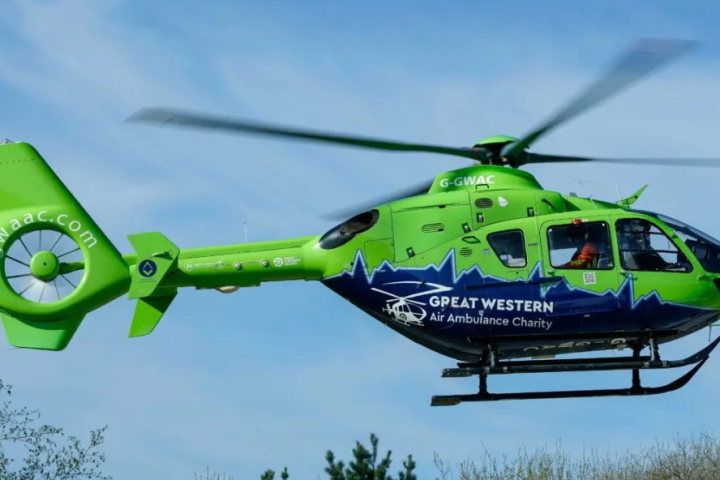
Great Western Air Ambulance Charity has responded to more emergencies than ever before, recording a second consecutive year of record demand across Gloucestershire, Bristol, Bath and North East Somerset, South Gloucestershire, North Somerset and parts of Wiltshire.
During 2025, Great Western Air Ambulance call-outs reached 2,344 people in urgent need of critical care. With one helicopter and three critical care cars available across the region, this represents an average of six additional call-outs per month compared with 2024. The charity’s crews include Critical Care Paramedics and Consultant Doctors, bringing hospital-level skills and equipment directly to patients at the scene.
By delivering advanced decision making and specialist treatment outside of hospital settings, the team aims to give patients the best possible chance of survival following serious illness or traumatic injury. In many cases, this care begins from a critical care car, with crew members transporting extensive medical equipment directly to the patient.
More than half of all Great Western Air Ambulance call-outs in 2025 were related to serious medical emergencies. Medical incidents accounted for 56 percent of missions, while trauma related injuries made up 44 percent. This marks a continued shift from previous years, when trauma had historically been more prominent.
Tim Ross-Smith, Operations Officer at Great Western Air Ambulance Charity, said the trend may reflect closer working relationships with land ambulance services. He said: “We’re getting more requests for assistance from our local land ambulance crews on top of the traditional air ambulance call-outs for incidents like road traffic collisions and cardiac arrests. This could be due to the outreach work our crew are doing, educating land paramedics about when we can add value to patients who are in urgent need of care. It’s helping our ambulance service colleagues have an increased recognition that our team can support with more nuanced decision making in complex situations.”
Cardiac arrest remained the single most common reason for Great Western Air Ambulance call-outs, with crews responding to 521 cases, representing 22 percent of all missions. Road traffic collisions followed with 362 incidents, alongside falls at 227, collapses at 185 and neurological or fitting incidents at 183.
One of those helped was 66 year old Pam Maggs, who suffered a sudden cardiac arrest at home. She said: “I’m here today because my husband immediately called 999, the paramedics gave me CPR and defibrillation, the GWAAC team kept me stable and got me to a specialist heart hospital. I’d encourage anyone to learn how to do CPR and find where their nearest defibrillator is so they know how to help in an emergency. And I’d say, please support GWAAC! They’re not part of the NHS and rely on donations to continue saving lives.”
Men accounted for nearly two thirds of all patients attended by the charity, while 341 babies, children and teenagers required urgent care, making up 15 percent of total Great Western Air Ambulance call-outs during the year.
Gloucestershire was the busiest area, with 677 call-outs, closely followed by Bristol with 668. South Gloucestershire recorded 323 missions, North Somerset 281, Wiltshire 138, Bath and North East Somerset 121 and Somerset 90. Crews were also tasked to 46 incidents outside their usual operating region, including in Wales.
Most patients were reached by road rather than air. Critical care cars were used in 74 percent of call-outs across the region and in 93 percent of missions within Bristol. Although the helicopter was deployed in 26 percent of taskings, only 2 percent of patients were transported to hospital by air. In most cases, treatment continued in the back of a road ambulance during transfer to the most appropriate hospital.
Anna Perry, Chief Executive Officer of Great Western Air Ambulance Charity, said: “Demand for our lifesaving service has never been higher and I feel very proud that GWAAC has been able to help a record number of people for a consecutive year. I’m especially proud because our charity has been facing increased operational costs and an increasingly tough fundraising environment. So, thank you to everyone who has donated, volunteered, taken part in sponsored events and bought from and donated items to our shops—you kept families together in 2025 and helped someone who was having their worst day.
“But we have a tough challenge ahead of us; we desperately want to be able to be there for everyone who needs us so we’re asking for support from our communities again in 2026. If you can, please donate and help us be there for more people in the future.”