
School pupils from Bristol, Luton and Pembrokeshire have helped create a new children’s book exploring airborne microfibres, after taking part in pioneering research with the University of the West of England (UWE Bristol).
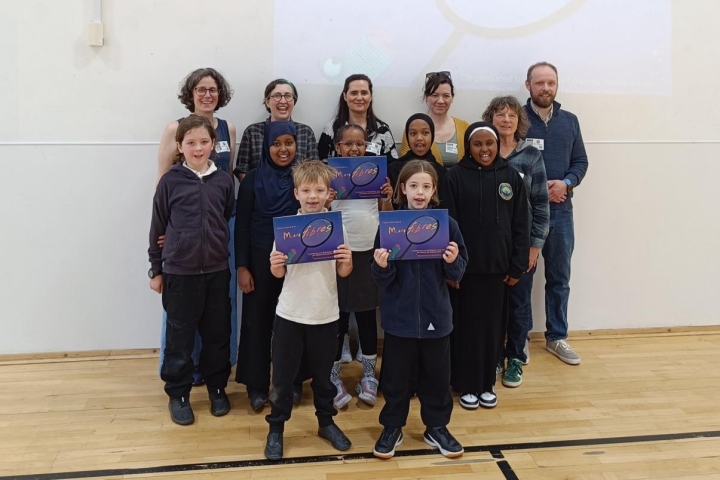
The book, ‘Taking a Close Look at Microfibres’, was launched on Earth Day at May Park Primary School in Bristol – one of the schools that took part in the Schools Under the Microscope project.
The child-led citizen science research enabled pupils aged nine to 11 to explore the presence of microfibres in the air within their schools. Following an initial pilot involving 90 pupils, the project expanded to include around 400 children across four schools – one secondary and three primary. This marked the first time data on airborne microfibres has been collected within the school environment.
Nat Brown, Year Six teacher at May Park Primary School said: “In most science lessons, as a teacher, you already know the outcome. You’re guiding the children towards a result you expect, hoping they’ll discover what you already know. This experiment was completely different. It was significant and exciting because we were contributing to a genuine unknown scientific investigation rather than a classroom exercise. For once, this wasn’t about leading pupils to a pre‑known answer; we were exploring something new together.”
Lesson plans and background information were given to the participating schools. Pupils prepared Petri dishes, made predictions, and placed dishes around school for two weeks, with everyone asked to not disturb the dishes. Pupils later used microscopes to count fibres, and researchers at UWE Bristol conducted additional analysis and fed back their findings.
Lead researcher, Dr Verity Jones, Associate Professor in Education at UWE Bristol, said: “While microfibres are well documented in water, far less is known about fibres in the air we breathe. Building on ‘Homes Under the Microscope’ methods, we were able to collect data on airborne microfibres in schools for the first time, allowing us to see if this method works in a classroom setting and to develop an educational resource with the new book.”
The project found that airborne microfibre levels in schools were similar to those found in homes, with a mix of natural and synthetic fibres – including colours matching the school uniforms.
“Throughout the project, it was clear that the pupils and teachers enjoyed contributing to real scientific research,” added Dr Jones. “It also increased awareness of air‑quality professions – an important focus for green futures and employment. It demonstrated that air pollution, though invisible, becomes meaningful through hands‑on activities.”
The book launch took place during a school assembly at May Park Primary School, Coombe Road, Eastville. Nat Brown from May Park Primary School also added: “The children really took ownership of the project, which was fantastic to see. One of the best things UWE Bristol did for us was provide access to high‑quality equipment. That technology allowed us to do things that simply wouldn’t have been possible in a primary setting without UWE Bristol’s support.”
The children’s questions, observations and learning helped shape the storyline and content of the new book, which provides teachers, parents and children with the opportunity to learn more and ask questions about what’s in the air.
Dr Margarida Sardo, Senior Research Fellow in Science Communication, added: “The project helped raise awareness of citizen science and what scientists are and what they do. As one child put it, it’s ‘not just potions and making things explode’.”
Socially engaged artist and arts-based researcher Luci Gorell Barnes made the illustrations in the book by scanning recycled plastics, fabrics, card and paper – all materials which shed microfibres – and then used these scans to create digital collages.
The book is available as an e-copy and as will be hosted as a hard copy in every library in Bristol and in local schools.
The project team is also partnering with the Global Goals Centre to work with schools across Bristol on the Better Uniform Campaign which seeks to build a more socially and environmentally just system for school uniforms.