
A former UK national security official has warned that blind faith in technology, populist figures and corporate power risks eroding democracy and destabilising the international order.
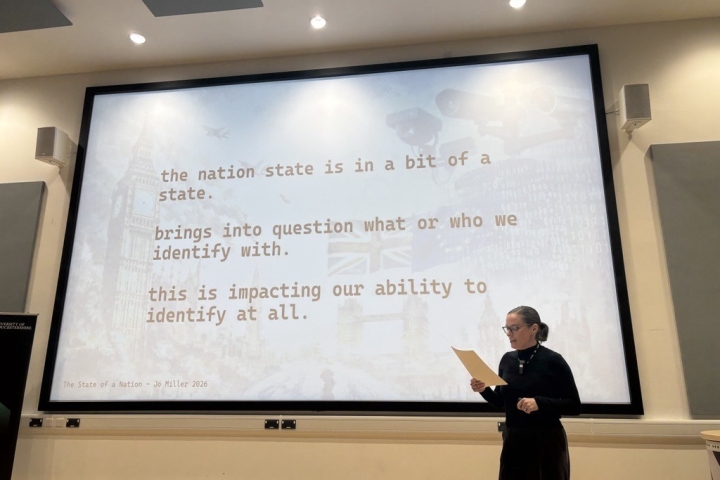
Delivering a State of a Nation lecture at the University of Gloucestershire, Jo Miller – formerly of the UK Government and now National Security Officer at Microsoft – set out a stark assessment of the pressures reshaping the rules-based system that has underpinned western stability for decades.
Addressing an audience of more than 150 at the University’s Park Campus, Miller argued that intensifying geopolitical uncertainty and rapid technological change are testing the resilience of democratic institutions. The post-war international framework, she suggested, is being strained not only by state actors but by the growing influence of commercial and technological forces that sit beyond traditional governance structures.
“Geopolitical uncertainty is driving behaviours that risk further undermining democracy and fracturing the rules-based international order,” she said.
At the centre of her warning was artificial intelligence. As public reliance on AI tools accelerates, Miller cautioned against treating them as neutral arbiters of truth. Their flaws, she noted, mirror our own.
“These models are designed based on the cognitive processes of the human brain,” she said. “Just as the human brain lies, fabricates, conflates opinion with fact, embellishes and misremembers, so do the tools that we have built to artificially replicate it.”
The greater danger, she argued, is not technological error but human abdication – the quiet surrender of critical thinking in favour of convenience, charisma or automation.
“Putting uninhibited faith – unquestioning faith – in technologies and popular figures” risks “handing over our agency”.
Miller broadened her focus to the shifting nature of the nation state itself. Global capitalism, corporate identity and the scale and speed of innovation are reshaping how citizens understand belonging and authority. The question is no longer simply geopolitical, but existential: who or what do we identify with in a world where power is diffuse and loyalties fragmented?
“We might conclude that the Nation State is in a bit of a state,” she observed, pointing to forces that have disrupted governance models that have endured for centuries.
Referencing tensions across the globe – from Venezuela to Taiwan – she questioned whether democratic societies are learning from history or repeating familiar patterns of complacency in the face of expanding superpower influence
Yet her conclusion was not fatalistic. The future, she insisted, remains open.
“Of course, the future, thankfully, is not yet written,” she said. “We have agency, and we must use it wisely and intelligently, and we must not give it away.”
The message was clear: in an era of AI acceleration and geopolitical flux, the gravest threat to democracy may not be technology or foreign adversaries – but the erosion of our willingness to question, reason and act.