
“Pilgrimage” is not just an old historical practice, or something done by characters in fantasy novels. The practice is well followed in the 2020s, and new information released today tells us just how much it’s done, and where people are going.
The British Pilgrimage Trust has published its 2025 rankings of the most-downloaded pilgrimage routes across England, Wales and Scotland. The data shows that interest in both historic long-distance routes and shorter, more accessible walks is strong, with walkers seeking connection to nature, cultural heritage, and spiritual reflection. Since 2014, the Trust has created the UK’s largest digital archive of pilgrimage routes, offering detailed guidance for hundreds of journeys across Britain.
Pilgrimage is increasingly being taken up for diverse reasons. Some walkers pursue spiritual practice or religious observance, while others aim for wellbeing, mindfulness, and time away from the constant pace of modern life. The Trust notes that walking routes shaped by centuries of human activity provide a deliberate contrast to digital connectivity, allowing space for reflection, attentiveness, and engagement with landscape and history.
Internationally, pilgrimage is often associated with routes such as the Camino de Santiago, but the Trust’s latest data demonstrates a renewed interest in Britain’s own ancient paths. These routes carry deep historical and spiritual significance and can be walked without the need to travel overseas.
“Historically, pilgrimage has often resurfaced at moments of social change,” says Guy Hayward, co-founder of the British Pilgrimage Trust. “What feels different now is that people are rediscovering pilgrimage not only as a religious practice, but also as a shared human one. It has become a way of walking with intention and care, whatever your beliefs.”
British churches, abbeys, and sacred spaces continue to welcome pilgrims. Many remain open for reflection or meditation. Through the Trust’s Sanctuary Network, walkers can also stay overnight in churches along their journeys, supporting a tradition of hospitality that stretches back centuries.
Research conducted by YouGov for the Trust in 2025 shows that while curiosity about pilgrimage is high, many people still see it as primarily a religious pursuit. Others cite concerns about cost, time, or logistical complexity. Yet the research highlights that meaningful pilgrimages can be undertaken in a single day with minimal equipment and little expense, making them accessible to a wide range of participants.
Since 2014, the Trust has guided thousands of pilgrims, recording their motivations. Emotional and mental wellbeing, connection with nature, spiritual curiosity, and interest in Britain’s rich cultural heritage are the most commonly cited reasons for walking pilgrimage routes. For many, the journey is about moving through landscapes with intention and purpose, visiting sites shaped over centuries, including holy wells, sacred springs, ancient trees, caves, hilltops, chalk figures, boundary stones, churches, abbeys, and cathedrals.
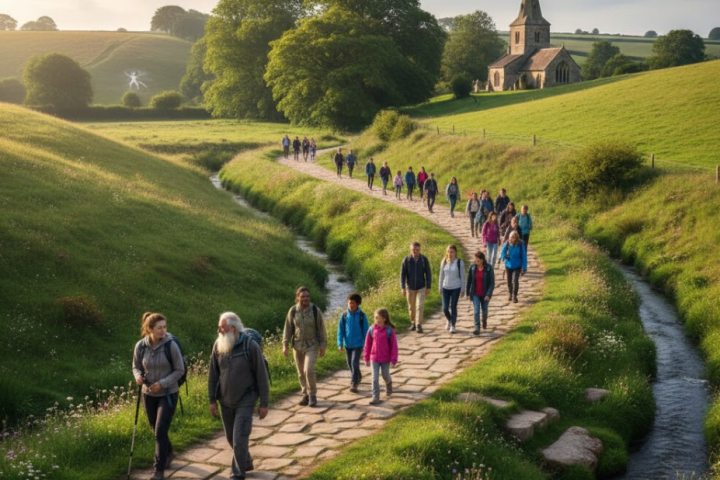
Pilgrimage is not only a personal journey but often a communal experience. Walking alongside others, sometimes in silence and sometimes in conversation, can foster reflection, empathy, and connection. It provides a chance to listen and engage, offering quiet ways to bridge social or cultural divides.
The Trust’s 2025 data highlights the UK’s top ten most-downloaded pilgrimage routes, spanning short micro-pilgrimages to long-distance journeys. Among these:
St James’ Way, Reading to Southampton – 66 miles
The official start of the Camino de Santiago in Britain, this route passes through the rolling countryside and open downs of Wessex.
The Pilgrims’ Way – Winchester to Canterbury (North Downs Pilgrims’ Way) – 153 miles
Perhaps Britain’s best-known pilgrimage path, first walked in 1172AD to visit Thomas Becket’s shrine in Canterbury. Evidence shows the route was used for thousands of years prior.
St Michael’s Way – St Michael’s Mount, Cornwall – 13 miles
A coast-to-coast micro-pilgrimage across western Cornwall. Highlights include ancient Irish saints, hilltop stones, and flowing holy water.
Golden Valley Pilgrim Way – Herefordshire and Wales – 60 miles
A circular route beginning and ending at Hereford Cathedral, with Sanctuary churches available for overnight stays.
Old Way – Southampton to Canterbury – 240 miles
Once used by European and British pilgrims visiting Thomas Becket’s shrine, rediscovered via the Gough Map from 1360. The route traverses wild and urban landscapes dotted with holy shrines.
Cornish Saints’ Way – Padstow to Fowey – 27 miles
Part of the Cornish Celtic Way, following routes likely taken by early Christian travellers from Ireland and Wales to Brittany and the European mainland.
St Alban’s Way – London to St Alban’s – 35 miles
From St Paul’s Cathedral to St Albans Cathedral, following the path to Britain’s first saint and martyr, Alban. Nearly two millennia of devotion mark this historic route.
The Archangel’s Way – Dartmoor – 38 miles
Passing through deep gorges, waterfalls, and tors such as Brat Tor and Black-a-Tor, the route highlights both nature and humanity’s impact on ancient landscapes.
Finchale Camino Inglés – Durham to Finchale Priory – 22 miles
An English section of the Camino de Santiago. It concludes at Finchale Priory, where St Godric began his own pilgrimage in the late 12th century.
Augustine Camino – Rochester to Ramsgate via Canterbury – Length variable
This route celebrates Kent’s early Christian heritage, featuring monasteries, village churches, cathedrals, and shrines of four major saints, as well as the final resting place of Thomas More’s head.
The resurgence of pilgrimage coincides with the Catholic Jubilee Year of 2025, a tradition encouraging spiritual journeys. “The Jubilee year has long been a moment for pilgrimage,” says Hayward. “What’s striking in 2025 is how that ancient rhythm is intersecting with contemporary concerns around wellbeing, heritage and slowing down.”
The data underscores that pilgrimage in Britain is no longer purely religious. It is a practice of cultural engagement, personal reflection, and shared human experience. With accessible routes, supportive networks, and growing awareness, more people than ever are rediscovering the value of walking with purpose, attention, and care.