

A service station on the A30 in Devon is set to become home to a new “Tiny Forest” in a first-of-its-kind partnership for National Highways.
The government-owned company is teaming up with environmental charity Earthwatch Europe to create a miniature, fast-growing native woodland at A30 Sourton Cross services, near Okehampton.
Funded through National Highways’ designated Innovation and Research funding, the project will see a 200 square metre plot transformed into a densely planted, layered woodland using the Japanese Miyawaki method. The technique encourages rapid growth and biodiversity by planting native species close together to replicate natural forest conditions.
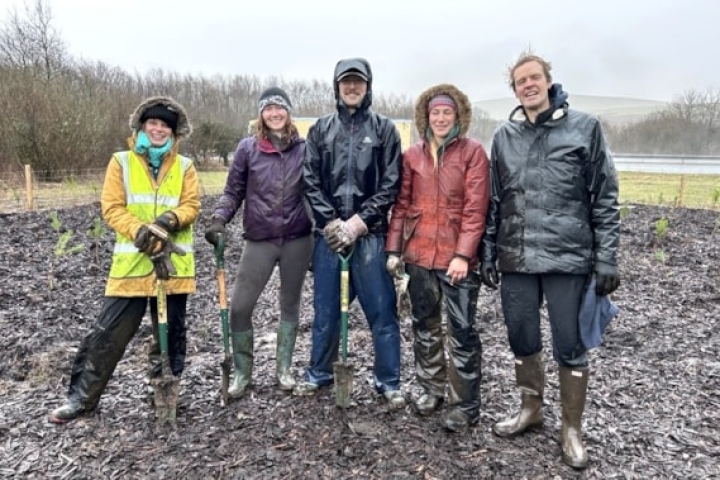
Community volunteers from the Okehampton area joined Earthwatch staff in recent weeks to plant 375 trees and shrubs at the site. Species include oak, hornbeam, birch, hawthorn, crab apple, field maple and hazel, alongside shrubs such as broom and guelder rose – all well suited to the Devon climate.
The trees were sourced through the Community Trees Programme, a partnership between National Highways, The Tree Council and Greenwood Plants, which donates trees to communities across the country.
Tiny forests are designed to store carbon, mitigate flooding and heat stress, attract wildlife and improve air quality. In time, the Sourton plot will also provide natural screening from the A30 and create an accessible green space where visitors can connect with nature during their journey.
Since 2020, Earthwatch has planted more than 300 tiny forests across the UK. As with its other projects, the development and growth of the Sourton woodland will be carefully monitored to assess environmental impact and long-term success.
Ben Hewlett, Senior Environmental Advisor at National Highways, said: “Our work goes beyond operating, maintaining and improving roads and through our designated funds, we’re investing in the environment and communities surrounding our network, as well as the people travelling and working on it, adding real value to society.
“It’s a first for us, and we’re delighted to be working with Earthwatch on this initiative, which will see us trialling a new technique to aid the establishment of trees and mitigate any losses.
“Tree planting and green spaces are a key part of our environmental commitment. We’re working to plant hundreds of thousands of trees by 2030 and as part of that initiative, the Sourton project will bring significant benefits in terms of biodiversity and a wildlife focus for local communities. It will also enhance the experience for all visitors using our well-used service area.”
Grace Gale, Project Manager at Earthwatch Europe, added: “This project provides rich opportunities for connecting communities with the environment and sustainability, and we’re thrilled to be working with National Highways to bring it to Sourton.
“It’s vital that we give people the knowledge and skills to protect our natural world and inspire them to take positive action from a young age.”
National Highways manages four designated funds aimed at delivering benefits beyond building, maintaining and operating England’s strategic roads. These funds focus on protecting the environment, enhancing landscapes, improving safety, reducing congestion, supporting communities and driving innovation and research.
Across the South West, designated funding has supported a range of environmental initiatives, including restoring and recreating 16.8 hectares of woodland, orchard, grassland and heathland across mid-Cornwall; improving water quality and biodiversity at Stover Country Park near the A38 in Devon; enabling grassland and wildflower projects along the A303 and M4 in Wiltshire, the A46 near Bath and the A35 in Dorset; and delivering wildflower and grassland schemes alongside the strategic road network in the Cotswolds.