
Meat-eating dinosaurs probably fed by dragging their teeth backwards through flesh like a saw rather than biting straight down like a dagger, new experiments suggest.
Scientists at the University of Reading and the University of Illinois Urbana-Champaign found that the curved, serrated teeth of theropod dinosaurs needed about a third less force to cut when pulled diagonally backwards than when pushed vertically downwards.
The study, published today [26 November] in Palaeontology is the first to physically test how well these “steak knife” teeth cut.
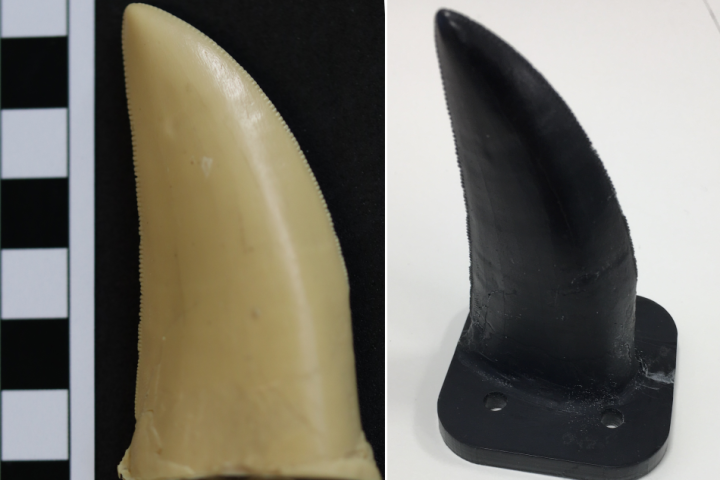
Theropods are the group of dinosaurs that includes Allosaurus and Velociraptor, as well as modern birds. Many had flat, curved teeth with serrated front and back edges, similar to a steak knife.
To test how these teeth worked, the team built a new machine called the DinoSAW. It pushed a replica theropod tooth from an allosaur into ballistics gel, a material often used to mimic flesh, either straight down or at a diagonal backward angle. Sensors recorded the forces involved.
Dr Manabu Sakamoto, a palaeobiologist at the University of Reading who led the study, said: “We often picture meat-eating dinosaurs crunching straight down on their prey, but their teeth tell a different story. These teeth are curved backwards and serrated on both edges, so we wanted to test whether pulling them through flesh worked better than biting down. It did, by a clear margin.
“This suggests these dinosaurs fed much like an eagle tearing at a carcass, sinking their teeth in and using their strong necks to pull back. It also means scientists modelling dinosaur skulls and teeth need to think about the direction of the bite, not just its strength.
“You might say this is the most cutting-edge dinosaur science ever conducted.”
Using the experimental DinoSAW machine, the researchers found that a diagonal pull needed an average peak force of 14 newtons, compared with 21.4 newtons for a vertical bite.
The researchers also filmed the gel under polarised light, which revealed stress inside the material. Vertical biting created bright flashes of concentrated stress, whereas diagonal pulling spread the stress more evenly and at lower levels.
The difference comes down to the tooth’s shape. A vertical bite only uses the serrated front edge of the tooth. A backward pull follows the tooth’s curvature and brings both serrated edges into play.
The researchers say this points to dinosaurs using their powerful S-shaped necks to tug at flesh. Birds of prey, which are living theropods, feed this way. So do Komodo dragons, the only living reptiles with similar teeth. Fossil bite marks on dinosaur bones, which often appear as grooves, also suggest teeth were dragged across the surface.
The findings challenge an earlier theory that theropods first bit down and then pulled. The new results suggest that approach would waste effort, and that pulling probably drove both the puncture and the cut.
“We can never truly know how an extinct animal behaved since we cannot directly observe it,” added study co-author Dr Philip Anderson, a professor of evolution, ecology and behaviour at the University of Illinois Urbana-Champaign. “But using theory and methods from physics and engineering allows us to investigate what types of feeding behaviours may have been more efficient and perhaps more likely to have occurred.”
The team plans to use the DinoSAW system to test other teeth and feeding motions, such as the cookie-cutter incisors of extinct sabre-toothed cats.