
Sir Garfield St Aubrun Sobers, universally acknowledged as the greatest all-rounder in the history of cricket and a titan of the sport, has died at the age of 89. His passing on Friday, 17 July 2026, marks the end of an era for the global cricketing community, which has lost one of its most cherished and transcendent figures.
Born in Bridgetown, Barbados, in 1936, Sobers redefined the parameters of what a single cricketer could achieve on the field. Across a spectacular international career spanning two decades, he dazzled spectators with his elegant yet destructive batting, mesmerised batters with three distinct styles of bowling, and patrolled the outfield with feline grace.
News of his death prompted an immediate outpouring of tributes from across the globe, uniting former teammates, modern players, and governing bodies in mourning. The West Indies cricket fraternity, Nottinghamshire County Cricket Club, and the International Cricket Council (ICC) have all expressed their profound sorrow at the loss of a man whose name became synonymous with cricketing excellence.
A Prodigy Forged in Barbados
Garfield Sobers was born on 28 July 1936 into a large, working-class family in the Bay Land area of St Michael, Barbados. Tragically, he lost his father to a German U-boat attack at sea when he was just five years old. Despite this early hardship, Sobers demonstrated a prodigious aptitude for all sports, excelling in football and basketball before dedicating his singular focus to cricket.
Making his first-class debut for Barbados at the tender age of 16 in 1953, his immense potential was immediately apparent. Just fourteen months later, he was drafted into the West Indies Test side for the 1953-54 series against England. Remarkably, the young Sobers was selected primarily as a slow left-arm orthodox bowler, batting at number nine. However, it did not take long for his transcendent batting abilities to force him up the order, where he would eventually terrorise bowling attacks worldwide.
By the time he retired from international duty in 1974, Sobers had amassed an astonishing 8,032 Test runs in 93 matches at a towering average of 57.78. To place this into context, his batting average remains the fifth-highest in the history of Test cricket among players with more than 5,000 runs. Alongside his run-scoring feats, he claimed 235 Test wickets at an average of 34.03 and took 109 catches, cementing a statistical footprint that no all-rounder has ever genuinely threatened to replicate.
Career in Numbers: Sir Garry Sobers
| Format | Matches | Runs | Batting Average | 100s/50s | Wickets | Bowling Average | 5-Wicket Hauls | Catches |
| Test | 93 | 8,032 | 57.78 | 26 / 30 | 235 | 34.03 | 6 | 109 |
| First-Class | 383 | 28,314 | 54.87 | 86 / 121 | 1,043 | 27.75 | 36 | 405 |
| List A | 95 | 2,721 | 38.32 | 1 / 18 | 109 | 22.26 | 1 | 41 |
Note: One-Day Internationals were introduced at the very end of his career; he played just one ODI in 1973.
The Defining Milestones: 365 Not Out and Swansea
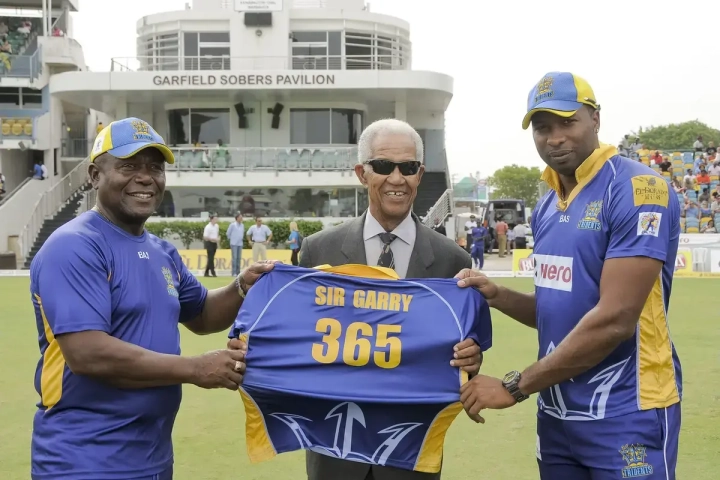
Sobers’ legacy is punctuated by moments of history-making brilliance that have etched themselves into the bedrock of cricket folklore. The first arrived in Kingston, Jamaica, in 1958. Facing a formidable Pakistan side, a 21-year-old Sobers converted his maiden Test century into a mammoth, unbeaten 365. In doing so, he eclipsed the great Sir Len Hutton’s world record for the highest individual score in a Test innings (364). It was an innings of supreme stamina and flawless technique, and the record stood as a towering monument for 36 years until another West Indian icon, Brian Lara, scored 375 on the very same ground in 1994.
A decade later, Sobers achieved a feat of explosive hitting that permanently altered the sport’s landscape. While captaining Nottinghamshire against Glamorgan at Swansea on 31 August 1968, he became the first batsman to hit six sixes in a single six-ball over in first-class cricket. The unfortunate bowler was Malcolm Nash, whose medium pace was dispatched with brutal disdain to all corners of the St Helen’s ground. It was a visceral display of raw power that confirmed Sobers’ status as a box-office draw capable of executing the seemingly impossible, cementing his legend in English domestic cricket.
The Complete Cricketer
What elevated Sobers above all his contemporaries, and indeed above those who followed, was his astonishing versatility. He was not merely a batsman who could bowl a bit, nor a bowler who could hold a bat. He was a genuinely world-class operator in every single discipline, capable of changing the trajectory of a match with any of his multi-faceted skills.
With the bat in hand, he possessed an unmistakable, high-uplift backlift, executing drives and pulls with a ferocious whip of the wrists. As a bowler, he was three men rolled into one. He could open the bowling with genuine fast-medium pace and prodigious swing. When the ball lost its shine, he could seamlessly transition to bowling tight, orthodox slow left-arm spin. If the pitch offered turn and bounce, he would deploy left-arm wrist-spin, bowling chinamen and googlies that completely bamboozled established top-order batsmen.
Furthermore, he was an exceptional fielder. Positioned close to the bat, often at backward short leg or slip, his reflexes were lightning-fast, resulting in over 400 catches throughout his vast first-class career, saving countless runs and acting as a lethal supplementary weapon for his own bowlers.
A Global Footprint: Nottinghamshire and Beyond
While his heart belonged to the Caribbean, Sobers’ brilliance was heavily showcased on the global domestic circuit. Following the advice of his mentor, the legendary Sir Frank Worrell, Sobers cut his teeth as a professional in the Central Lancashire League with Radcliffe Cricket Club between 1958 and 1962. The unforgiving nature of league cricket sharpened his competitive edge, famously resulting in a rare double of 1,008 runs and 144 wickets in 1961.
His most profound domestic impact in England, however, came at Trent Bridge. When county cricket relaxed its regulations on overseas players, Nottinghamshire secured his signature for the 1968 season. Arriving as the incumbent West Indies captain, he immediately assumed the Nottinghamshire captaincy, transforming a side that had languished in 15th place into formidable title contenders who finished fourth in his debut summer. He went on to score more runs for Nottinghamshire than for any other domestic side.
Today, Nottinghamshire County Cricket Club released a poignant statement mourning their former leader. “Nottinghamshire are extremely saddened to hear of the passing of Sir Garfield Sobers,” the club declared. “Widely regarded as cricket’s greatest ever all-rounder, Sobers amassed 7,041 First-Class runs for Notts… including 18 centuries. He also contributed 281 wickets… He topped his county’s batting averages in all but two of his seasons with the club, playing a major part in our history.”
Sobers also enjoyed highly successful stints in Australia with South Australia, bringing his unique flair to the Sheffield Shield. He earned widespread adoration from the Australian public during his time there, a mutual affection that culminated in him being appointed an Officer of the Order of Australia (AO) in 2003.
Leadership and Honours
Sobers was entrusted with the captaincy of the West Indies in 1965, leading the side until 1972. His leadership style mirrored his natural play: aggressive, instinctive, and always seeking to entertain the crowd. He also notably captained the Rest of the World sides in England in 1970 and Australia in 1971-72, stepping up to replace cancelled tours by South Africa and demonstrating his supreme batting form against the world’s finest bowlers.
His contributions to the game and to his country were recognised at the highest levels of global society. He was knighted for his services to cricket by Queen Elizabeth II in 1975, shortly after his retirement. In 1998, an act of the Barbadian Parliament named him as one of the original ten National Heroes of Barbados, granting him the prestigious and exclusive title of “The Right Excellent.”
His standing within the pantheon of cricketing greats was formally quantified in 2000 when the Wisden Cricketers’ Almanack convened a panel of 100 global experts to select the Five Cricketers of the 20th Century. Sobers finished second in the voting, securing 90 out of 100 votes, placing him behind only the immortal Sir Donald Bradman. In 2004, the ICC immortalised his legacy by naming their annual trophy for the Men’s Cricketer of the Year the “Sir Garfield Sobers Trophy,” ensuring his name remains at the absolute pinnacle of the sport every single year.
The Final Innings
As the cricketing world digests the monumental news of his passing today, the reflections will inevitably centre on the sheer joy he brought to the pitch. Sir Garry Sobers played cricket with a radiant smile and a swagger that captivated post-war audiences. He was a sporting pioneer who proved that one man could genuinely do it all, setting a benchmark for the all-rounder that has survived the advent of modern professional training, sports science, and hyper-specialisation.
There have been many great cricketers since his retirement in 1974, and there will undoubtedly be many more in the decades to come. However, it is a near-universal consensus among historians, players, and fans alike that the game will never again bear witness to a talent quite as complete, quite as explosive, or quite as majestic as Sir Garfield Sobers. His legacy is permanently woven into the grass of Kensington Oval, Trent Bridge, and every ground where the game is played.