
As the curtain fell on the 2026 Commonwealth Games following a spectacular closing ceremony at the OVO Hydro on Sunday evening, the global sporting focus naturally shifted toward the overarching dominance of the Australian machine. Amassing a staggering 170 medals, the athletes in green and gold were the undeniable statistical victors of the fortnight. However, look slightly beyond the summit of the medal table, and the true narrative of these Games emerges: the extraordinary, defiant, and historic performances of the UK home nations.
Stepping in to host a condensed, 10-sport programme following the late withdrawal of Victoria, the city of Glasgow provided an electric, highly partisan atmosphere across its four primary venues. Feeding off the deafening roars of the home crowds, the athletes from England, Scotland, Wales, and Northern Ireland delivered a catalogue of iconic moments, breakthrough triumphs, and emotional farewells that will be etched into the annals of British sporting history.
Here is a comprehensive review of how the home nations performed at the Glasgow 2026 Commonwealth Games.
England: Boxing Brilliance and Multi-Sport Depth
Team England finished a highly commendable second on the overall medal table, accumulating a massive 110 medals in total. Comprising 29 golds, 45 silvers, and 36 bronzes, the English delegation provided a masterclass in depth, consistently threatening the podium across every discipline on the schedule.
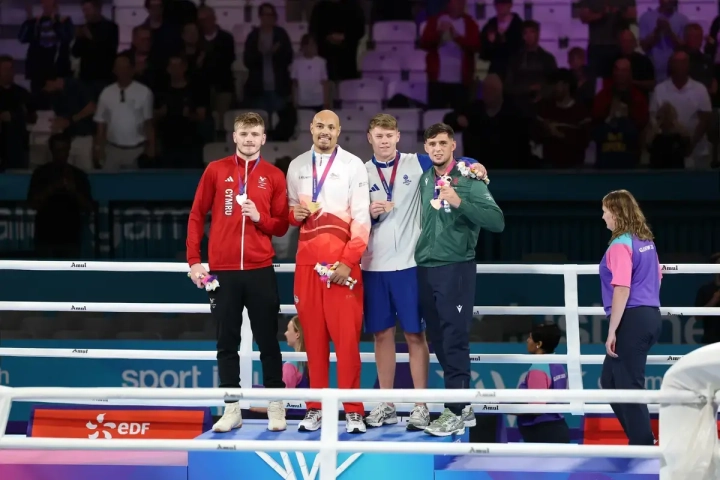
The unquestionable highlight of England’s campaign occurred inside the SEC Arena, where the national boxing squad delivered their best Commonwealth Games return in 40 years. Securing an outstanding total of 10 medals, the English pugilists were absolutely ruthless on Finals Day. Sacha Hickey set the tone in the women’s 65kg category, demonstrating immense composure to secure a unanimous decision victory over Ireland’s Kaci Rock. Shortly after, Patris Mughalzai solidified his status as arguably the boxer of the tournament, taking gold in the men’s 65kg division.
The momentum in the ring continued as Isaac Okoh combined technical brilliance with trademark showmanship to claim the 90kg title. Damar Thomas then brought the curtain down in fitting fashion, securing the super-heavyweight (90+kg) gold. In doing so, Thomas ensured England retained a historic grip on a division previously championed by the likes of Joe Joyce, Frazer Clarke, and Delicious Orie.
Beyond the ropes, English athletes thrived on the judo tatami and the athletics track. Kelly Petersen-Pollard enjoyed a defining moment in her career, upgrading her Birmingham 2022 bronze to Glasgow 2026 gold in the women’s -70kg judo category after a gruelling golden score victory over Australia’s Aoife Coughlan. Ethan Nairne enjoyed a dream Games debut, winning the men’s -73kg title, while Emma Reid claimed a brilliant gold in the -78kg division.
At Scotstoun Stadium, Jazmin Sawyers finally captured her elusive first major outdoor title, leaping 6.93m in the women’s long jump to edge out Nigeria’s Ruth Osoro. Georgia Hunter Bell completed her collection of major medals with a stunning victory in the 800m, while Sophie Hahn, displaying her customary resilience, dominated the T37/38 100m. Adding to the haul, Olympic icon Emily Campbell proved unstoppable once again, taking gold in the women’s +86kg weightlifting category.
To add further gloss to England’s campaign, the Tollcross International Swimming Centre witnessed a flurry of English success. Alice Tai stormed to gold in the women’s 100m backstroke S9, while Georgia Sheffield and William Ellard secured respective titles in the women’s and men’s 200m freestyle S14 categories. Over at the gymnastics arena, Luke Whitehouse dazzled the judges to claim the men’s floor title, perfectly showcasing the multi-disciplinary strength of the English squad.
Scotland: The Host Nation’s Poster Boy
For the host nation, the Glasgow 2026 Commonwealth Games were an unmitigated triumph, both organisationally and athletically. Scotland finished a highly respectable fifth on the medal table, securing 39 medals, including a superb return of 13 golds.
While success was spread across multiple disciplines, the defining image of the Games was undeniably forged on the track at Scotstoun Stadium by Scottish poster boy Josh Kerr. Competing in the men’s one-mile event, a historic distance returning to the Games after a 60-year absence, Kerr arrived burdened with the immense expectations of an adoring home crowd. Having broken the indoor mile world record earlier in the year, the 28-year-old faced a phenomenally strong field containing three of the last four world 1500m champions, including his compatriot Jake Wightman, as well as the highly touted 20-year-old Australian wunderkind Cameron Myers.
In a highly tactical, physical race that occasionally resembled a contact sport, Kerr masterfully bided his time. With 250 metres remaining, the Scot unleashed a devastating, piston-like kick that entirely eviscerated the competition. Accompanied by a deafening roar from the stands and celebratory blue and white smoke billowing around the stadium, Kerr crossed the line in 3:54.12, winning by a comfortable margin over Myers and Kenya’s Timothy Cheruiyot. Wightman, the only athlete bold enough to initially attempt to match Kerr’s blistering acceleration, ultimately faded to finish sixth.
“It doesn’t get any better than this,” an elated Kerr told reporters in the immediate aftermath. “To do it in front of a Scottish crowd where I learned how to race… this is absolutely incredible.” His gold medal not only cemented his status as a middle-distance great but provided the host city with its ultimate signature moment of the fortnight.
Wales: Finucane Rules the Velodrome
Wales punched significantly above their weight throughout the condensed 11-day schedule, finishing ninth overall with 31 medals, nine of which were gold. The undeniable catalyst for this impressive national success was 23-year-old track cycling sensation Emma Finucane, who effectively transformed the Sir Chris Hoy Velodrome into her own personal kingdom.
Finucane departed Glasgow as one of the standout athletes of the entire Commonwealth Games, securing an astonishing four gold medals, accounting for nearly half of the entire Welsh gold medal haul. Her absolute dominance was best encapsulated in the women’s individual sprint final. Facing off against her Great Britain teammate and close friend, England’s Sophie Capewell, Finucane displayed a serene ruthlessness. She executed two flawless races in the best-of-three final, claiming the Commonwealth title with a Games record time of 10.322 seconds.
Her ability to manage the intense psychological pressure of competing against familiar domestic rivals, while simultaneously shouldering the expectations of the Welsh delegation, showcased a maturity far beyond her years. With compatriot Rhian Edmunds also securing bronze in the sprint event, Welsh cycling announced itself as a formidable, elite international force.
Northern Ireland and the Glasgow Legacy
Northern Ireland concluded the Games in 13th place on the medal table, securing a highly commendable haul of 10 medals (one gold, two silvers, and seven bronzes). Their athletes consistently threatened the podium across several events, proving the depth of sporting talent across the entire United Kingdom and ensuring all four home nations were heavily represented in the medal ceremonies.
Ultimately, while the Australian delegation dominated the overall statistical standings, the UK home nations can reflect on Glasgow 2026 with immense, enduring pride. Born out of the dire necessity to rescue the Commonwealth Games movement, the streamlined “Glasgow Model” relied heavily on the atmosphere generated by passionate, knowledgeable local crowds. The home athletes fed off this unique energy, delivering historic milestones and spectacular breakthrough performances.
As the Commonwealth baton is officially passed to Ahmedabad, India, for the 2030 centenary edition, the stars of England, Scotland, Wales, and Northern Ireland have firmly etched their names into the storied history of the Games, proving beyond any doubt that there truly is no place like home.
Final Medal Standings: UK Home Nations
| Rank | Nation | Gold | Silver | Bronze | Total |
| 2 | England | 29 | 45 | 36 | 110 |
| 5 | Scotland | 13 | 9 | 17 | 39 |
| 9 | Wales | 9 | 10 | 12 | 31 |
| 13 | Northern Ireland | 1 | 2 | 7 | 10 |