
A Dominant Statement in the Pacific Northwest
The 2026 FIFA World Cup narrative continues to unfold rapidly, and the United States have emphatically stamped their authority on Group D. On Friday, 19 June 2026, kicking off at 20:00 BST, a vibrant Seattle Stadium in Washington state witnessed the tournament co-hosts systematically dismantle a resilient Australian side. Despite the significant pre-match blow of losing talismanic captain Christian Pulisic to a calf injury, the Americans cruised to a highly convincing 2-0 victory. Following an impressive 4-1 triumph over Paraguay in their opening fixture, this latest success effectively guarantees the host nation’s passage into the newly expanded Round of 32 with a game to spare.
For the travelling Australian supporters, the evening proved immensely frustrating. Arriving in the Pacific Northwest buoyed by a shock victory over Turkey, the Socceroos were completely outplayed during a remarkably one-sided first half. The result leaves Tony Popovic’s squad facing a nervous final group match to secure their own knockout aspirations, as their early momentum was halted abruptly by a superior American collective.
First Half: American Ascendancy and Australian Errors
Stepping onto the pitch under the gaze of a passionate home crowd, the United States immediately established control of the tempo. Deploying a fluid tactical formation under the guidance of Mauricio Pochettino, the midfield pivot of Tyler Adams and Weston McKennie completely suffocated the Australian engine room. The statistics painted a stark picture of the hosts’ overwhelming dominance: by the half-time interval, the Americans had registered a staggering 88 percent pass completion rate and successfully completed 259 passes compared to Australia’s mere 78.
The relentless pressure yielded its first tangible reward just 11 minutes into the contest. Following a well-rehearsed set-piece routine that targeted the edge of the penalty area, the Australian defensive line was caught entirely flat-footed. In a desperate attempt to clear the danger, towering centre-back Cameron Burgess inadvertently directed the ball into his own net past goalkeeper Patrick Beach. The calamitous 11th-minute own goal instantly ignited the Seattle crowd and forced the visitors to abandon their initially cautious, defensive blueprint.
Despite falling behind, the Socceroos struggled to mount any meaningful offensive response. Their attacking trio of Mohamed Touré, Nishan Velupillay, and Mathew Leckie were hopelessly isolated, starved of service by a disjointed midfield. American full-backs Antonee Robinson and Sergiño Dest frequently pushed high up the pitch, adding immense width to the attacks and forcing the Australian wing-backs into a deep, defensive posture.
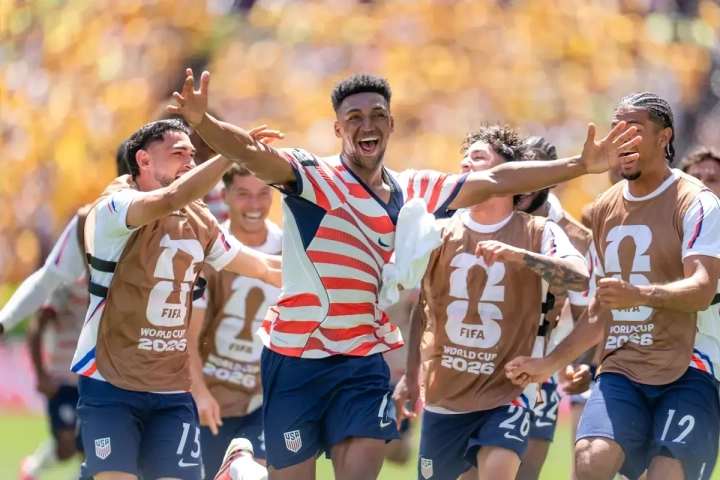
The decisive knockout blow arrived shortly before the break. In the 43rd minute, full-back Alex Freeman found himself venturing deep into the attacking third. Capitalising on a momentary lapse in concentration from the retreating Australian defenders, Freeman unleashed a clinical strike that comfortably beat Beach, extending the lead to 2-0. The goal effectively crushed the remaining oceanic resistance and sent the host nation into the dressing room completely in control of their destiny.
Popovic’s Tactical Gamble and Second-Half Grit
Recognising the dire nature of his side’s performance, Australian manager Tony Popovic executed a dramatic triple substitution during the half-time break. Seeking to inject much-needed energy and unpredictability, he introduced Jason Geria, Connor Metcalfe, and explosive teenage winger Nestory Irankunda in place of Burgess, Velupillay, and Touré. The tactical reshuffle slightly altered the dynamic of the match, as the visitors began to apply sporadic pressure through increased physical intensity and a more aggressive high press.
However, the heightened intensity inevitably led to a string of cynical fouls and yellow cards. The second period became a fiercely contested, attritional battle rather than a flowing spectacle of football. Robinson became the first American to enter the referee’s notebook following a clumsy challenge in the 55th minute, joining Australians Jordan Bos and Alessandro Circati who had been cautioned earlier in the contest.
The Americans expertly managed the tempo, absorbing the isolated waves of Australian pressure while maintaining an undeniable threat on the counter-attack. Dest, in particular, remained a constant menace on the right flank, forcing a spectacular save from Beach deep into stoppage time. While the Socceroos demonstrated commendable grit and determination in the second half, they lacked the necessary creative guile to genuinely threaten Matt Freese in the American goal.
Closing Stages and Match Management
As the clock ticked past the 70-minute mark, the match evolved into an exercise in pragmatic game management for the United States. With progression virtually assured, the coaching staff smartly utilised their substitute bench to rest key personnel and preserve energy for the demanding challenges ahead. Sebastian Berhalter was introduced to anchor the midfield, followed swiftly by Joe Scally and Auston Trusty to completely solidify the defensive structure.
The final stages of the encounter were heavily punctuated by a flurry of late cautions. Australian substitutes Harry Souttar and Jacob Italiano were both shown yellow cards in the 88th minute as frustration finally boiled over, while American forward Folarin Balogun and defender Chris Richards were also booked during a chaotic, ill-tempered conclusion to the match. To help navigate the final moments of extensive stoppage time, veteran striker Haji Wright and dynamic midfielder Giovanni Reyna were brought onto the pitch, ensuring the hosts saw out the victory with absolute professionalism.
Tournament Implications and The Road Ahead
When the final whistle mercifully echoed across the stadium, the contrasting emotions were highly palpable. Securing back-to-back victories provides the United States with a monumental psychological boost. They have emphatically proven that they can dominate elite opposition and navigate high-pressure environments even without their most influential attacking player. The performance of Alex Freeman, who was widely recognised as the unofficial Player of the Match, highlights an exceptional depth of talent that will serve them incredibly well during the knockout rounds.
Conversely, the heavy defeat forces Australia back to the drawing board. Popovic’s tactical setup was completely overwhelmed during a disastrous opening 45 minutes, exposing severe structural vulnerabilities that must be urgently addressed. They now face a monumental, do-or-die clash in their final group fixture, acutely aware that another lacklustre display will result in a premature flight back to the Southern Hemisphere. On a night where attacking fluidity and tactical discipline reigned supreme, the United States sent a resounding message to the rest of the footballing world.
Official Match Facts
Goalscorers:
- United States: Cameron Burgess (11′ Own Goal), Alex Freeman (43′)
Discipline:
- United States: Antonee Robinson (Yellow Card, 55′), Folarin Balogun (Yellow Card, 88′), Chris Richards (Yellow Card, 90+2′)
- Australia: Jordan Bos (Yellow Card, 15′), Alessandro Circati (Yellow Card, 31′), Harry Souttar (Yellow Card, 88′), Jacob Italiano (Yellow Card, 88′)
Substitutions – United States:
|
Minute |
Player On |
Player Off |
|
73′ |
Sebastian Berhalter |
Ricardo Pepi |
|
79′ |
Joe Scally |
Sergiño Dest |
|
79′ |
Auston Trusty |
Antonee Robinson |
|
90+5′ |
Haji Wright |
Folarin Balogun |
|
90+5′ |
Giovanni Reyna |
Weston McKennie |
Substitutions – Australia:
|
Minute |
Player On |
Player Off |
|
45′ |
Jason Geria |
Cameron Burgess |
|
45′ |
Connor Metcalfe |
Nishan Velupillay |
|
45′ |
Nestory Irankunda |
Mohamed Touré |
|
60′ |
Cristian Volpato |
Mathew Leckie |
|
77′ |
Jackson Irvine |
Paul Okon-Engstler |