
Brazil and Japan meet in one of the most intriguing ties of the FIFA World Cup round of 32 today, with a place in the last 16 at stake and two very different footballing stories converging in Houston. The match takes place on Monday, 29 June 2026, at NRG Stadium, officially listed for tournament purposes as Houston Stadium, with kick-off at 6pm UK time, 12 noon local time in Texas.
For Brazil, this is the beginning of the phase by which every World Cup campaign is ultimately judged. Carlo Ancelotti’s side came through Group C unbeaten, finishing first after taking seven points from matches against Haiti, Scotland and Morocco. The five-time world champions now step into knockout football carrying expectation, attacking momentum and the familiar demand that anything short of a serious title challenge will be considered a disappointment.
Japan arrive with a different but equally compelling sense of purpose. Hajime Moriyasu’s team progressed from Group F as runners-up, collecting one win and two draws to extend their reputation as one of the most organised and technically assured sides outside the traditional power blocs. Their challenge in Houston is not merely to trouble Brazil, but to take a step Japanese football has never managed at a men’s World Cup: winning a knockout-stage match.
That makes this fixture more than a meeting between a global heavyweight and an ambitious challenger. It is a test of Brazil’s readiness under a manager still completing his first major tournament with the national team, and a measure of whether Japan’s steady rise across recent World Cups can finally be converted into a breakthrough result when the margins are at their thinnest.
Brazil’s group campaign offered plenty of encouragement. They opened by beating Haiti, were held by Scotland, and then secured top spot with victory over Morocco. Their most recent competitive fixture, the win against Morocco, was particularly important because it removed any lingering uncertainty about their position in the section and allowed Ancelotti to guide his squad into the knockouts without the pressure of a final group-day scramble.
The attacking numbers have strengthened the belief around the Seleção. Vinícius Júnior has been among the standout performers of the tournament, giving Brazil direct running, end product and a constant threat from wide areas. Matheus Cunha has also produced important goals, adding movement and sharpness through central attacking zones. Around them, Brazil possess the kind of technical depth that can stretch opponents in several ways rather than relying on a single pattern.
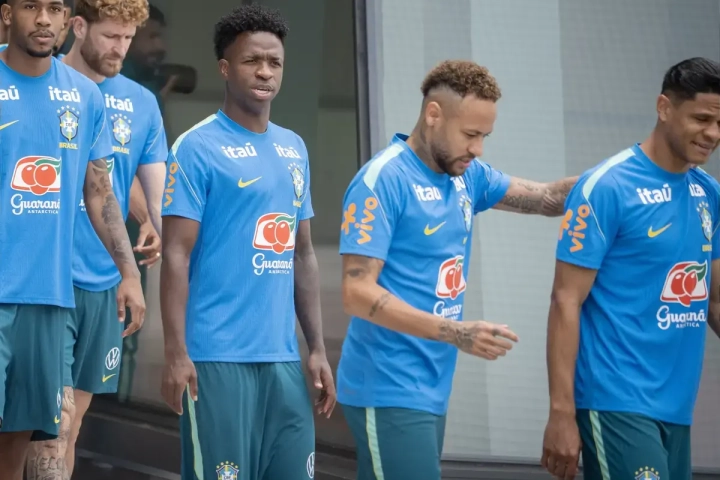
Neymar’s role remains one of the major talking points. Having returned to action during the group stage after a long absence from the national side, he made a brief appearance in the 3-0 win over Scotland and Ancelotti has indicated that the forward is now ready for more involvement. That does not necessarily mean he will start, but his availability gives Brazil another high-class option as the match develops and adds another layer to Japan’s defensive planning.
There are no confirmed Brazil suspension issues dominating the build-up, and the main availability story concerns how Ancelotti manages Neymar’s minutes rather than any enforced reshuffle. In tournament football, that distinction matters. Brazil enter the match with selection choices rather than a selection crisis, which allows their manager to think not only about today’s opponent but also about the demands that could follow if they progress.
Tactically, Brazil are likely to seek control without becoming predictable. Ancelotti’s best sides have usually combined structure with individual freedom, and that balance is visible in this team. Brazil can build through midfield, accelerate through the wide forwards, and commit full-backs at carefully chosen moments. Against Japan, their patience may be tested by a side comfortable defending compactly and springing forward with speed when possession changes hands.
Defensively, Brazil have also shown signs of balance. Their back line has benefited from experienced organisation and the protection of midfielders willing to recover quickly when attacks break down. That will be essential against Japan, whose transitions are clean, direct and often built around intelligent movement rather than hopeful long balls.
The psychological element should not be ignored either. Brazil have not lifted the World Cup since 2002, and every knockout match since then has carried the weight of national longing. The shirt, the history and the size of the fanbase can inspire players, but they can also add pressure. Ancelotti’s calm authority is one reason Brazil appointed him, and this is exactly the kind of occasion where that composure will be expected to count.
Japan, meanwhile, come into the tie with confidence built not just from this tournament but from a longer body of work. Under Moriyasu, they have beaten elite opponents in recent years and developed a reputation for tactical intelligence, collective discipline and ruthless counter-attacking when space appears. Their group-stage return was not spectacular, but it was enough to confirm progression and underline their resilience.
Their most recent competitive fixture secured the point they needed to reach this stage. Japan’s progress from Group F, behind the Netherlands and ahead of Sweden and Tunisia, reflected consistency across three matches rather than one dramatic result. In a group where every mistake had consequences, they remained calm enough to navigate the section unbeaten.
The absence of Takefusa Kubo is a confirmed setback. The Real Sociedad attacker offers imagination, ball-carrying and set-piece quality, and his unavailability removes one of Japan’s most creative options in the final third. Moriyasu, however, has built his team around collective adaptability, and Japan’s system is not dependent on one player. That will be tested against Brazil, but it is also one of the reasons they have become such awkward opponents at this level.
Daichi Kamada and Ayase Ueda have both provided important attacking contributions during the tournament, giving Japan quality between the lines and a focal point in advanced areas. Daizen Maeda’s energy and pressing can also be valuable in a match where Brazil’s defenders and midfielders will expect to see plenty of the ball. Japan will need those qualities if they are to disrupt Brazil’s rhythm and turn defensive phases into meaningful attacks.
Moriyasu’s handling of potential penalties has become another interesting storyline. After Japan’s painful shootout defeat by Croatia at the 2022 World Cup, he has made clear that he will take responsibility for selecting penalty takers if this match goes the distance. It is a small detail, but in knockout football such details often reveal how deeply previous disappointments shape current preparation.
The tactical picture for Japan is clear but demanding. They must stay compact enough to reduce space for Brazil’s wide attackers while avoiding the temptation to retreat too deep for too long. Their midfield will need to screen central passing lanes, their full-backs must judge when to step out, and their forwards must offer an outlet whenever possession is regained. It is a game that will require endurance as much as intelligence.
Previous meetings add a particularly interesting edge. Brazil have historically held the upper hand in this fixture, but Japan’s 3-2 friendly victory last October has ensured this knockout tie is not viewed as a formality. That result will not decide anything in Houston, yet it proved Japan can hurt Brazil when given the chance and provided Ancelotti’s players with a clear warning about the danger of underestimating them.
There is also a deeper football relationship between the two nations. Brazilian influence has long been part of Japan’s football development, from the growth of the J-League to the presence of Brazilian players and coaches who helped shape the domestic game. That history gives this match a symbolic quality: Japan are facing a nation that helped inspire part of their football identity, but they do so now as a mature international side with ambitions of their own.
The wider tournament implications are straightforward. The winner advances to the round of 16, where they will meet the winner of Ivory Coast against Norway. For Brazil, progression would keep alive the pursuit of a sixth world title and maintain the sense that Ancelotti’s side are gathering force at the right moment. For Japan, victory would represent one of the most important results in their football history and a powerful statement about their place in the modern game.
Key battles are likely to emerge across the pitch. Brazil’s wide forwards against Japan’s defensive line may shape the rhythm of the match, while Japan’s ability to press Brazil’s midfield without leaving gaps behind them could determine whether they can create enough attacking moments. Set-pieces, substitutions and game management may become increasingly important if the match remains tight into the second half.
Houston is set for a fixture carrying colour, history and clear competitive stakes. Brazil bring star power, tradition and the burden of expectation. Japan bring organisation, belief and the hunger to break through a barrier that has stood for decades. By early evening in the UK, the World Cup will have another knockout storyline ready to unfold, with one team moving closer to its ultimate ambition and the other left to wonder whether this was the moment that slipped away.