
Now that the engines are silent, the grandstands are empty, and the telemetry data has replaced the roar of the crowd at the Circuit de la Sarthe, the true story of the 2026 24 Hours of Le Mans can finally be told. Twenty-four hours after the #7 Toyota GR010 Hybrid crossed the finish line to secure the Japanese manufacturer’s sixth overall victory, the weekend’s breathless sprint has transitioned into a cold, analytical post-mortem.
The bare facts of the 94th running are already etched into motorsport history: 381 laps completed, an emotional redemption exactly a decade after Toyota’s infamous 2016 last-lap heartbreak, and a maiden victory for Nyck de Vries alongside the now two-time winners Kamui Kobayashi and Mike Conway.
However, looking at the final classification through a purely chronological lens misses the point entirely. In the modern Hypercar era, Le Mans is no longer an endurance race of survival; it is a 3,000-mile sprint executed with the precision of high-speed grandmaster chess. When a 24-hour race featuring the world’s most advanced hybrid machinery is decided by a razor-thin margin of just 10.913 seconds over the #20 BMW M Hybrid V8, the outcome is not determined by raw pace alone. It is decided by a succession of micro-margins, thermal windows, and structural discipline.
The Cost of a Micro-Error: Frijns’ Pit-Entry Miscalculation
In a race decided by less than eleven seconds, every single modern pit stop, driver change, and slow zone is magnified under an analytical microscope. Monday morning’s data charts highlight one definitive moment where the balance of power permanently shifted away from Munich and toward Cologne.
With just under five hours remaining on Sunday morning, the #20 BMW M Team WRT entry was operating at the absolute peak of its powers. Robin Frijns was pushing the car to its absolute limits, maintaining a narrow but sustainable advantage over the chasing pack. Then came the entry to the pit lane, a transition area that drivers negotiate dozens of times over a weekend, yet one that remains treacherous when fatigue sets in.
Frijns locked his front tires on the painted lines of the deceleration zone, skipping across the gravel trap. While the car escaped without structural damage, the physics of the mistake were catastrophic for BMW’s track position. The time lost navigating the gravel, combined with the subsequent cleanup during the pit stop cycle, allowed both the leading Cadillac and the surging #7 Toyota to capitalize. In a category where top teams run identical paces down to the tenth of a second, spotting your closest rival a ten-second advantage on pit entry is an unmitigated disaster. It proved to be the exact mathematical deficit that BMW could never quite claw back.
The Thermal Swing: How Michelin Lifecycle Decided the Finish
The structural complexity of the 2026 race was heavily dictated by ambient conditions. With daytime temperatures on Saturday soaring toward 30°C, tire management shifted from a secondary concern to the primary performance differentiator.
Early on, the #7 Toyota crew looked entirely out of the running after a painful puncture forced an unscheduled stop, dropping them deep into the field. This required a highly aggressive, high-risk recovery strategy that relied entirely on maximizing tire longevity during the cooler night hours.
|
Time Period |
Track Conditions |
Key Hypercar Performers |
Strategic Impact |
|
Saturday Afternoon |
Intense Heat (30°C) |
BMW #20, Cadillac #12 |
Severe tire degradation; early puncture for Toyota #7 |
|
Overnight (00:00–05:00) |
Rapid Cooling |
Cadillac #12, Toyota #8 |
Grip levels plummeted; eight cars within one minute |
|
Sunday Afternoon |
Peak Thermal Output |
Toyota #7 (Kobayashi) |
Medium-compound Michelins optimised; masterclass defence |
As darkness enveloped the 13.6-kilometer circuit, track temperatures plummeted, completely altering braking points and aerodynamic balances. At 02:00 local time, the race was a spectacular stalemate: eight cars representing four distinct manufacturers were separated by less than sixty seconds. The #12 Cadillac V-Series R, driven with immense discipline by Louis Delétraz, Will Stevens, and Norman Nato, traded the lead with the #20 BMW and the sister #8 Toyota.
The decisive tactical shift occurred during Sunday afternoon’s final three hours. As track temperatures climbed back to their peak, the medium-compound Michelin Pilot Sport Endurance tires on the #7 Toyota found an optimal performance window that the BMW garage simply could not match. While the BMW suffered from marginal rear-end instability as the track greased up, Kamui Kobayashi found himself with a perfectly balanced platform. Taking the wheel for the final stint, Kobayashi’s defensive display was not just about blocking lines; it was a masterclass in tire preservation, maintaining identical lap times from the start of his stint to the drop of the checkered flag.
The Execution Deficit: Internal Discipline vs. Technical Gremlins
If the #7 garage provided the blueprint for execution, the rest of the Hypercar grid served as a warning of how quickly a Le Mans campaign can derail.
The internal heartbreak at Toyota Gazoo Racing lay with the #8 crew of Sébastien Buemi, Brendon Hartley, and Ryo Hirakawa. They looked arguably faster than the sister car throughout Sunday morning, but an infraction during a Full Course Yellow (FCY) period resulted in a costly drive-through penalty. The penalty effectively erased them from the lead battle, forcing a spectacular but ultimately frustrating recovery drive to finish third, 20.417 seconds back.
For other heavyweights, the race was a brutal reminder of the event’s unforgiving nature:
- Hertz Team JOTA (#38): Sébastien Bourdais, Jack Aitken, and Earl Bamber showed immense pace before a terminal mechanical failure forced a heartbreaking retirement just before dawn.
- Genesis Magma Racing: The newcomers suffered a brutal baptism of fire. The #17 Hypercar failed to finish, while the #19 sister car spent hours in the garage resolving severe technical gremlins, dropping entirely out of competitive running.
LMP2: A Masterclass in Operational Survival
Down in the ultra-competitive LMP2 category, the Polish squad Inter Europol Competition delivered an absolute clinic in execution, securing a historic 1-2 finish. The trio of Jakub Śmiechowski, Tom Dillmann, and Nick Yelloly piloted the #43 Oreca 07-Gibson through 361 flawless laps, closely shadowed by their teammates in the #343 machine.
The LMP2 narrative was defined by the stark contrast between mechanical consistency and sudden disaster. The #30 Duqueine Team entry, driven by Doriane Pin, Julien Andlauer, and Richard Verschoor, had controlled the pace for the vast majority of the 24 hours. However, with less than four hours remaining, a catastrophic brake failure forced them into immediate retirement, a cruel reminder that at Le Mans, the car must survive the strain of prolonged thermal load.
Conversely, Forestier Racing by Panis provided the ultimate comeback story. An early error by Louis Rousset dropped the #29 car a full lap down, but impeccable night-time stints from Esteban Masson and Oliver Gray allowed them to claw their way back to secure the final spot on the class podium.
LMGT3: The Stint That Silenced the Field
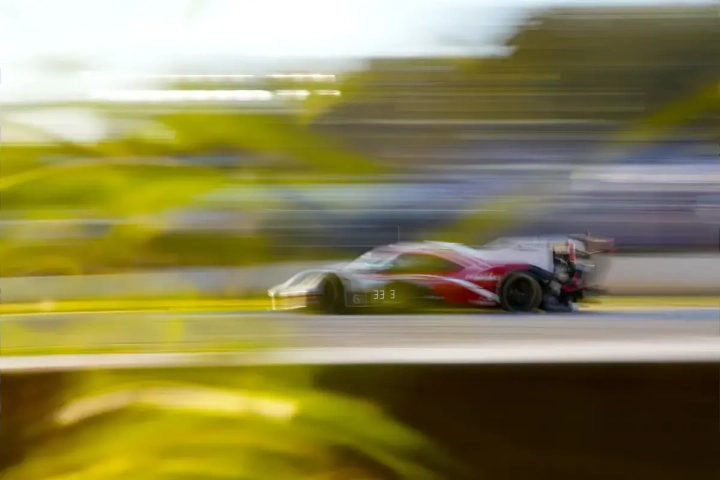
The newly established LMGT3 class witnessed a relentless, qualifying-style pace from flag to flag, shattering previous speed metrics for GT racing at La Sarthe. Emerging at the top of the 25-car field was the #33 TF Sport Corvette Z06 LMGT3.R, securing Corvette Racing’s tenth class victory at the venue.
The victory was constructed on a brilliant, asymmetric driver-utilization strategy. Ben Keating, the designated Bronze-rated driver, cleared his mandatory driving time almost entirely during the stable daylight hours of Saturday. This left the professional drivers to manage the treacherous night-to-day transition.
The standout performance of the class belonged to young British driver Jonny Edgar. Tasked with bringing the car home, Edgar executed a stunning, physically gruelling quintuple stint at the end of the race. This relentless display completely demoralized the pursuing Akkodis ASP Lexus #78 of Jack Hawksworth, Hadrien David, and Tom van Rompuy, while the Heart of Racing Team Aston Martin Vantage completed a diverse manufacturer podium.
The Monday Morning Reality: Championship Fallout
As the teams pack up their hospitality units today, the wider implications for the 2026 FIA World Endurance Championship are profound.
Despite missing out on the biggest trophy in motorsport by an agonizing ten seconds, the #20 BMW M Team WRT crew of Frijns, Rast, and van der Linde leave France with their heads held high. The double-points structure of Le Mans means their second-place finish provides a massive haul that successfully protects their status as current WEC points leaders heading into the second half of the season.
For Toyota Gazoo Racing, the double podium is a massive injection of momentum into their manufacturer championship aspirations. More importantly, it re-establishes their psychological dominance over the Hypercar class. In a weekend where every component, strategy call, and athlete was pushed to the absolute breaking point, Toyota proved that when the margins are reduced to seconds, their decade of hybrid endurance experience remains the gold standard.
2026 24 Hours of Le Mans Official Results
Hypercar (Overall Top 5)
- #7 Toyota Gazoo Racing (M. Conway / K. Kobayashi / N. de Vries) – 381 Laps
- #20 BMW M Team WRT (R. Frijns / R. Rast / S. van der Linde) – +10.913s
- #8 Toyota Gazoo Racing (S. Buemi / B. Hartley / R. Hirakawa) – +20.417s
- #12 Hertz Team JOTA (L. Delétraz / W. Stevens / N. Nato) – +32.381s
- #51 Ferrari AF Corse (A. Pier Guidi / J. Calado / A. Giovinazzi) – +2:22.423s
LMP2 (Top 3)
- #43 Inter Europol Competition (J. Śmiechowski / T. Dillmann / N. Yelloly) – 361 Laps
- #343 Inter Europol Competition (B. Garg / R. de Gerus / N. Müller) – +1 Lap
- #29 Forestier Racing by Panis (L. Rousset / E. Masson / O. Gray) — +2 Laps
LMGT3 (Top 3)
- #33 TF Sport Corvette (B. Keating / J. Edgar / N. Catsburg) – 336 Laps
- #78 Akkodis ASP Team Lexus (T. van Rompuy / H. David / J. Hawksworth) – +44.112s
- #23 Heart of Racing Team Aston Martin (G. Newell / E. Barrichello / J. Adam) – +1:05.188s