
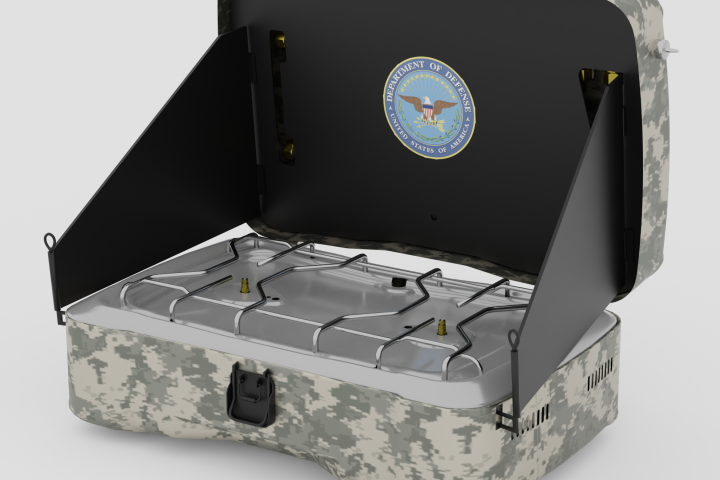
KINETIC7 the disruptive deep tech company founded by Australian entrepreneur and philanthropist Rick Parish – has confirmed that it has begun discussions with key members of Capitol Hill and the defence ecosystem about the benefits of integrating Kinetic7’s proprietary technology into the U.S. defence and federal markets.
It comes at a time of geopolitical instability and a global energy security crisis following the closure of the Strait of Hormuz which has in turn caused the largest disruption of oil supply in decades. The ripple effects of the global energy crisis have impacted major supply and manufacturing supply chains with higher energy prices, soaring inflation and reduction of supply.
While the world debates and procrastinates on how to produce and use sustainable hydrogen gas safely, Kinetic7 has achieved a global breakthrough in developing and safely producing hydrogen gas on demand. The Kinetic7 technology produces hydrogen (HHO) gas on demand as and when needed with zero emissions, making it safe, clean, affordable energy that is accessible to everyone, everywhere and even in the remotest of locations.
The Abu Dhabi based company – with offices in the UK, Australia, Italy and the U.S. – has pioneered a unique multi-patented delivery mechanism and several portable delivery platforms that have safely harnessed the production and delivery of hydrogen gas on demand (HOD).
The innovation dispenses with the need to capture and store hydrogen gas, which has traditionally been dangerous and is extremely expensive to build infrastructure and storage. It is indeed these restrictions – which have now been overcome with Kinetic 7’s proprietary technology – which previously hampered wide scale roll out and adoption of hydrogen gas energy.
Glenn Vogel (USMC Veteran), an investor and Kinetic7’s U.S. Federal and Commercial advisor believes the Kinetic7 technology brings an unrivalled energy solution to the U.S. defence sector and federal ecosystems.
“Logistics isn’t just a cost, it’s a signature. By removing the need for fuel transport and storage, Kinetic 7 inherently reduces the operational footprint, which directly supports survivability in contested environments.”
For the U.S. Department of Defense, Kinetic 7’s hydrogen technology provides a compelling operational advantage by eliminating hydrogen storage entirely while also avoiding diesel or propane logistics. Hydrogen is generated at the point of use and immediately consumed, removing the safety, transport, and resupply risks associated with stored fuels.
This approach significantly reduces convoy requirements, fuel lift, and sustainment exposure in contested or austere environments, while enabling essential thermal functions such as cooking without reliance on liquid fuels or grid power. By converting heat generation into a locally produced, on demand energy capability, Kinetic 7’s system transforms a persistent logistics liability into a predictable, low risk, mission support function—directly supporting DoD priorities around survivability, operational flexibility and lifecycle cost reduction.
Vogel added.
“Kinetic7’s unique proposition isn’t just about generating hydrogen; it’s about collapsing the logistics chain. In U.S. defense operations, reducing fuel transport isn’t a convenience, it’s a force protection strategy. Fewer convoys means fewer targets.”
U.S. Special Operations Command and the Department of Defense conduct rapid deployments requiring efficient supply lines with the ability to move immense quantities of supply globally. Stakeholders have identified significant limitations due to reliance on traditional supply chains for power generation and Class III fuel (flammable liquids). This dependence not only restricts operational flexibility and increases risk in austere environments but also hinders the ability to adapt to evolving threats and maintain a technological edge. Kinetic7 is the solution.
Kinetic7 is also in discussions with U.S. based engineering and manufacturing companies who design, build, and integrate specialized ground support, expeditionary water, power, medical, and base camp thermal systems for the Department of Defense and select commercial customers. We intend to work with trusted partners who are known for translating complex operational requirements into ruggedized, deployable solutions manufactured to military and industrial standards.
Commenting on the breakthrough Kinetic7 Chairman and founder Rick Parish said
“Hydrogen gas has existed since the very start of evolution, but understanding how we can create, capture and use hydrogen gas safely has eluded even the greatest of minds. When we were innovating Kinetic 7, we asked ourselves what if we didn’t need to store hydrogen gas but instead could create it on demand.Today we have managed to harness the method of creating, producing and delivering hydrogen gas safely, on demand, without the need for storage. This circumnavigates the process of storing hydrogen gas and means that our Kinetic 7 gas is 100% safe and can be created on demand when it is needed.
The scale and interoperability of Kinetic7 means it can be developed into multiple operating platforms from our portable Tribe™️ and Nomad™️ cook stoves – for humanitarian use, military deployment, disaster management and emergency services – to our commercial and residential HODbox™ for domestic and business energy supply.”
Originally the Kinetic7 technology was conceived to be used as a portable cooking stove for humanitarian use in developing nations. Kinetic7 has designed and produced the Tribe™️ and Nomad™️ stoves which are currently in production and will be ready to launch in the coming months. Both portable cooking stoves run off battery and solar power and can also be used for humanitarian, disaster relief, military and emergency services use. The technology also meets 13 of the 17 United Nations sustainable development goals (SDG)
The Kinetic7 technology has also pivoted to address the wider global energy crisis impacting both the business and domestic energy markets. Two much larger hydrogen on demand units called HODbox™ have been designed and developed for the commercial catering market and the other for the domestic residential energy markets.