
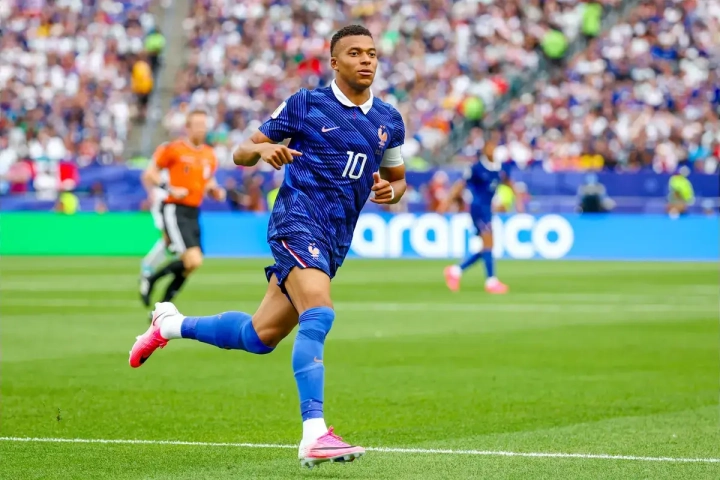
While Lionel Messi was busy scaling the ultimate mountain in Texas, the player universally recognised as his heir apparent was staging a ruthless assault on the record books on the East Coast.
France’s Group I encounter with Iraq in Philadelphia was an evening defined by milestones, meteorological chaos, and the sheer inevitability of Kylian Mbappé. The 27-year-old French captain has long been touted as the man who will eventually rewrite every major attacking record in international football. Against Iraq, he provided mathematical proof that the hype is entirely justified, matching Miroslav Klose’s tally of 16 World Cup goals with terrifying efficiency.
The Centurion in Philadelphia
Before a ball was even kicked at Lincoln Financial Field, Mbappé had secured his place in French footballing history. Walking out against Iraq marked his 100th international cap for Les Bleus. Reaching a century of appearances at just 27 years of age is a monumental testament to his durability, his unwavering form, and his importance to the national setup since his breakout tournament in 2018.
He celebrated the landmark almost immediately. France started the match with blistering intensity, completely overwhelming the Iraqi defence. In the 14th minute, combining brilliantly with Michael Olise, Mbappé utilised his devastating pace to breach the high defensive line. He unleashed a thunderous left-footed strike to score his 15th World Cup goal, moving past Gerd Müller and drawing level with the legendary Brazilian striker, Ronaldo.
The Elements and the Interruption
Before Mbappé could add to his tally, nature intervened. Severe thunderstorms swept across Philadelphia, featuring heavy lightning and torrential downpours that forced the officials to suspend the match. The players were taken off the pitch, resulting in a gruelling two-hour weather delay.
In tournament football, such prolonged interruptions can be psychologically draining. The adrenaline fades, muscles cool down, and tactical momentum is entirely lost. When play finally resumed, Iraq attempted to use the break to reorganise their defensive shape, sitting deeper to deny the French forwards space in behind.
However, Mbappé’s focus remained razor-sharp. He spent the remainder of the first half and the early stages of the second constantly probing the Iraqi flanks, waiting for a lapse in concentration.
The 16th Goal and the Statistical Anomaly
That lapse arrived in the 54th minute. Following immense, high-intensity pressing from Ousmane Dembélé, the Iraqi backline committed a catastrophic error, surrendering possession deep in their own penalty area. Mbappé was perfectly positioned to capitalise, tapping the ball into an empty net to double France’s lead.
That simple tap-in carried monumental historical weight. It was his 16th World Cup goal, drawing him perfectly level with Miroslav Klose as the joint second-highest goalscorer in tournament history.
While tying Klose is an incredible achievement, it is the underlying mathematics of Mbappé’s record that should terrify opposition defences. Miroslav Klose required 24 matches across four World Cups to reach 16 goals. Lionel Messi took 28 matches across six tournaments to surpass him.
Kylian Mbappé has scored his 16 goals in just 16 appearances.
Averaging precisely 1.00 goal per game on the sport’s most unforgiving and heavily scrutinised stage is a statistical anomaly in the modern era. Not since Just Fontaine scored 13 goals in six games in 1958, or Gerd Müller scored 14 in 13 games during the 1970s, has a player demonstrated such lethal, sustained efficiency at the World Cup.
The Future Trajectory
To contextualise Mbappé’s trajectory, one must look at his historical output. He scored four goals as a teenager during France’s victorious 2018 campaign. He followed that up by winning the Golden Boot in 2022 with eight goals, including a historic hat-trick in the final against Argentina. Now, in 2026, he is adding to that tally with frightening ease.
At 27, Mbappé is currently in the absolute prime of his athletic career. Barring serious injury, he has at least one, and potentially two, more World Cups ahead of him. While Messi currently holds the outright record at 18 goals, the Argentine is operating at the end of his career. Mbappé sits just two goals behind him with a lifetime of international football left to play.
The question is no longer whether Kylian Mbappé will break the all-time World Cup scoring record; it is simply a matter of when, and by what margin he will completely obliterate it.