
A Disjointed Yet Emphatic Display in Pennsylvania
In an encounter that will be remembered as much for meteorological chaos as it will for footballing excellence, France comprehensively defeated Iraq 3-0 to secure their place in the 2026 FIFA World Cup knockout stages. Staged beneath the towering architecture of the Philadelphia Stadium in Pennsylvania, the Group I fixture officially commenced at 22:00 BST on Monday, 22 June 2026. What was initially anticipated to be a straightforward assignment for Didier Deschamps’s men rapidly evolved into a gruelling test of endurance, primarily due to an unprecedented 130-minute weather delay at half-time. Nevertheless, the European heavyweights remained entirely unfazed by the severe disruption, leaning on the peerless brilliance of Kylian Mbappé to systematically dismantle a resilient but ultimately outclassed Iraqi side.
For the Lions of Mesopotamia, the heavy defeat leaves their historic World Cup journey hanging by the thinnest of threads. Earning their first appearance at the global showpiece in 40 years, the Middle Eastern nation must now rapidly recover from consecutive losses if they are to salvage any hope of progressing as one of the best third-placed teams.
First-Half Patience and an Early Breakthrough
Stepping onto the damp Kentucky bluegrass, the French squad immediately seized absolute territorial control. Operating in their fluid 4-2-3-1 formation, the midfield pivot of Manu Koné and Adrien Rabiot completely dictated the early tempo. The European side patiently circulated possession, probing a rigid, deeply entrenched 4-5-1 Iraqi defensive block assembled by head coach Graham Arnold.
The opening stages were characterised by immense physical intensity, highlighted by an early yellow card for Iraqi midfielder Amir Al-Ammari in the fifth minute following a late, mistimed challenge. Despite the robust resistance, the persistent deadlock was broken through a moment of sweeping, cohesive brilliance just 14 minutes into the contest.
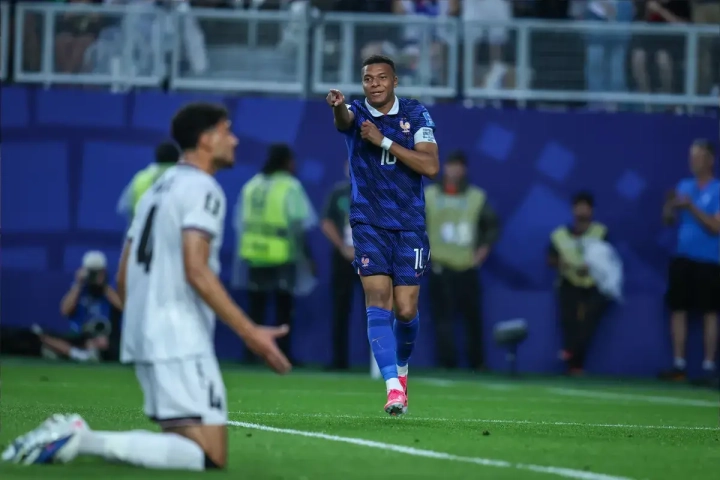
Operating menacingly on the right flank, Michael Olise delivered a beautifully measured, piercing pass that completely bypassed the retreating Iraqi defenders. Collecting the ball on the edge of the penalty area, Mbappé effortlessly shifted his weight, gliding past a desperate challenge before unleashing a thunderous, curling right-footed strike. The ball arrowed spectacularly beyond the dive of goalkeeper Ahmed Basil and into the near post. The clinical finish was deeply significant, arriving on the occasion of the 27-year-old’s 100th international appearance for his country, instantly sparking joyous celebrations among the travelling French contingent.
Compounding the misery of the early setback, Iraq suffered a monumental structural blow just over ten minutes later. Talismanic striker Aymen Hussein, who netted his nation’s only goal of the tournament in their opening defeat to Norway, sustained an apparent muscular injury. The visibly distressed forward was forcefully substituted in the 25th minute, replaced by Ali Al-Hamadi, completely depriving the Asian representatives of their primary attacking focal point.
The Storm of the Century
Just as the opening forty-five minutes drew to a close, severe weather sweeping across the American Eastern Seaboard dramatically changed the course of the evening. Heavy rain that had persisted throughout much of the first half drastically intensified, accompanied by spectacular, menacing lightning strikes within the immediate vicinity of the stadium.
Adhering to strict, mandatory safety protocols implemented by both local authorities and FIFA, match official Drew Fischer immediately halted proceedings and ordered both sets of players from the field. Stadium scoreboards flashed severe-weather warnings, instructing thousands of poncho-clad spectators to immediately evacuate the open seating bowl and seek emergency shelter within the venue’s covered concourses.
Under tournament regulations, play cannot safely resume until there has been a prolonged, uninterrupted period without any electrical activity detected within an eight-mile radius. Continued storm activity repeatedly reset the mandatory 30-minute countdown clock, resulting in a remarkable and exhausting 130-minute delay. Grounds crews worked tirelessly throughout the suspension, utilising large squeegees to shuttle standing water off the swampy pitch. The unprecedented break served as a gruelling mental test for both squads, who were forced to maintain their physical readiness and tactical focus while confined to their respective dressing rooms.
A Costly Blunder and the Second-Half Restart
When the players finally re-emerged to resume the fixture, the psychological impact of the monumental delay was immediately evident. While Deschamps’s seasoned professionals smoothly re-established their passing rhythm, the lengthy stoppage appeared to completely shatter the fragile concentration of the Iraqi defensive unit.
Merely nine minutes into the second half (54′), a horrific, entirely self-inflicted defensive mistake effectively ended the contest as a competitive spectacle. Attempting to calmly build out from the back, defender Zaid Tahseen played a dreadful, severely under-hit pass towards his goalkeeper. Ousmane Dembélé, showcasing phenomenal anticipation, ruthlessly intercepted the loose ball deep inside the penalty area. Displaying elite unselfishness, the Ballon d’Or-winning forward calmly squared a pass to an unmarked Mbappé. The French captain required no second invitation, effortlessly tapping a right-footed finish into the unguarded net to double the advantage.
The goal propelled Mbappé into elite historical territory. Marking his 16th career World Cup goal, the strike saw him permanently tie German legend Miroslav Klose for second place on the all-time tournament scoring list, sitting just two behind newly crowned record-holder Lionel Messi.
Dembélé Seals the Emphatic Victory
Having successfully broken the stubborn Iraqi resistance for a second time, Les Bleus rapidly moved through the attacking gears, playing with an undeniable swagger. In the 66th minute, the European heavyweights added a glorious third goal to their impressive tally, heavily orchestrated once again by the creative ingenuity of Olise.
Spinning brilliantly near the edge of the penalty arc, the dynamic playmaker utilised the outside of his left boot to thread an incisive, defence-splitting pass. Dembélé seamlessly controlled the delivery in his stride, bursting into the 18-yard box before dispatching a clinical, low finish past the despairing dive of Basil. The comprehensive strike served as a fitting reward for Dembélé’s tireless attacking contributions throughout the fractured evening.
Substitutions and Tactical Game Management
Entering the final quarter of the match with an unassailable three-goal cushion, both managers astutely recognised the opportunity to rotate their exhausted squads. Arnold executed a sweeping series of alterations to his beleaguered side, introducing Aimar Sher, Marko Farji, Rebin Sulaka, and Youssef Amyn in a desperate bid to inject much-needed energy into the midfield. While Iraq produced a brief, commendable spell of possession following the changes, they fundamentally failed to register a single shot on target, never truly bothering French custodian Mike Maignan.
Conversely, Deschamps intelligently utilised his deep bench to protect his most prized assets. The sensational Olise and the industrious Dembélé were respectfully withdrawn in the 67th minute, replaced by the youthful exuberance of Rayan Cherki and Désiré Doué. Later in the half, Bradley Barcola and Jules Koundé made way for Maghnes Akliouche and Malo Gusto, entirely refreshing the French flanks.
In the 90th minute, Mbappé was finally granted a well-deserved rest, replaced by Marcus Thuram to a rapturous standing ovation from the sodden Philadelphia crowd. The French captain was universally praised and rightfully awarded the Player of the Match accolade, his historic brace having single-handedly dictated the tempo and outcome of the gruelling encounter.
Group I Implications and The Road Ahead
When the final whistle mercifully echoed across the cavernous stadium, the contrasting emotions displayed by the two nations were stark. The emphatic 3-0 triumph mathematically guarantees France’s progression to the newly expanded Round of 32. Sitting comfortably at the summit of Group I with six points, the 2018 champions and 2022 finalists have completely justified their pre-tournament billing as genuine title contenders. They will now eagerly anticipate a highly demanding final group-stage clash, knowing that their knockout momentum has been thoroughly secured.
For Iraq, the heavy defeat represents a significant, highly damaging setback. Remaining on zero points after two matches, their ambitious hopes of reaching the knockout phases are now hanging precariously in the balance. Arnold must urgently address the glaring defensive frailties exposed in Pennsylvania and somehow rebuild the shattered confidence of his squad. They face an absolutely monumental, do-or-die fixture against Senegal in their concluding match, acutely aware that anything less than a miraculous victory will result in a premature flight back to the Middle East.