
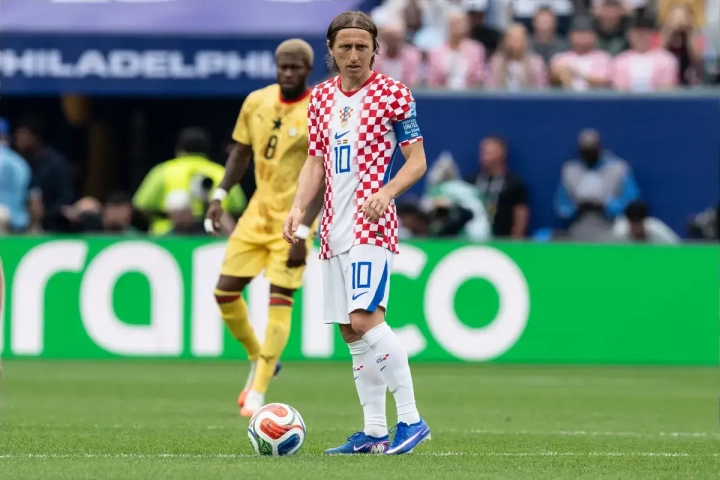
Croatia booked their place in the knockout stage of the World Cup with a hard-earned 2-1 victory over Ghana in Philadelphia, a result that carried far more tension and significance than many had expected before kick-off. What had been billed in some quarters as a potentially cautious final Group L meeting became a competitive, rain-soaked contest full of tactical shifts, long-range threat, VAR drama and one more decisive contribution from Luka Modrić, whose influence continues to stretch beyond age, expectation and tournament logic.
The match began with both sides aware that the group situation was delicately balanced. Ghana had already placed themselves in a strong position after their earlier results, while Croatia needed a positive outcome to make certain of their own progress. England’s position at the top of the group meant Croatia were playing not only for survival but also for second place, and Zlatko Dalić’s side approached the evening with the urgency of a team unwilling to leave anything to chance. Ghana, managed by Carlos Queiroz, knew a draw would likely be enough to preserve their route into the next phase, but the danger of playing too conservatively against a side as experienced as Croatia was clear from the early stages.
The conditions in Philadelphia added to the sense of occasion. Rain had fallen during the day and the slick surface made the ball zip quickly across the pitch. Croatia adapted better in the opening exchanges, using the width of the field to stretch Ghana’s defensive shape and looking to draw their opponents away from the compact central areas where the Black Stars are often most comfortable. Ivan Perišić provided an outlet on the left, Mateo Kovačić looked to drive forward from midfield, and Modrić, as ever, drifted into pockets of space where he could control the tempo with minimal fuss.
Ghana started with discipline but not much attacking freedom. Queiroz’s side were organised, compact and physically committed, but they struggled to build sustained possession in the first half. Antoine Semenyo carried occasional threat when Ghana tried to break, yet the Black Stars were too often forced backwards by Croatia’s midfield pressure. The opening warning arrived when Nikola Vlašić struck the post from distance, a sign of Croatia’s willingness to shoot early rather than overplay around a crowded penalty area.
The breakthrough came in the 31st minute and it was a moment of real quality. Petar Sučić collected the ball centrally and, with Ghana’s defence slow to close him down, struck a low effort from long range. The shot travelled through bodies, skidding through the wet surface before finding the corner of the net. It was a goal that rewarded Croatia’s more positive approach and changed the mood of the contest immediately. Ghana had been trying to manage the game carefully, but falling behind forced them to confront a different kind of pressure.
Croatia deserved their half-time lead because they had been the braver side with the ball. They were not overwhelming Ghana with relentless chances, but they had shown greater intent, sharper movement and more willingness to take risks in the final third. Modrić’s passing gave Croatia rhythm, Kovačić added energy through the middle, and Sučić’s goal reflected a team confident enough to test Ghana from distance. For Ghana, the first half was frustrating. Their defensive structure had largely held, but their lack of attacking ambition meant Croatia were able to grow into the match without being forced into uncomfortable defensive situations.
Queiroz responded at the interval by adjusting Ghana’s shape and introducing fresh attacking energy. The changes brought more urgency and gave the Black Stars greater presence higher up the pitch. Ernest Nuamah, in particular, helped Ghana play with more directness and confidence. Suddenly, Croatia were no longer controlling the spaces as comfortably. Ghana began to win more second balls, push their full-backs higher and deliver more dangerous set-pieces into the Croatian penalty area.
The equaliser arrived in the 73rd minute and carried its own layer of drama. A Ghana free-kick was delivered with pace and curve, and Derrick Luckassen reacted superbly inside the area. Making his international debut, he adjusted his body cleverly and guided the ball back across goal to beat the goalkeeper. The assistant’s flag initially checked the celebrations, with offside given on the field, but the VAR review took the referee to the monitor and the decision was eventually overturned. Ghana’s players celebrated with relief and emotion, while Croatia were left frustrated that a match they had largely controlled was suddenly level.
For Luckassen, it was a special personal moment. To score on debut at a World Cup would be memorable in any circumstances, but to do so in a decisive final group match made it even more significant. His goal also rewarded Ghana’s improved second-half approach. They had shown more adventure after the break and deserved credit for refusing to let the match drift away from them.
The equaliser changed the atmosphere completely. Ghana sensed that the draw might be enough, while Croatia knew the situation could still become dangerous if they lost control. Dalić’s side, however, have built much of their modern tournament identity on composure in difficult moments. Even after Ghana’s equaliser, they did not panic. They pushed forward again, raised the tempo and found another gear just as the match appeared to be slipping into a nervous final stretch.
The decisive moment came in the 83rd minute. Mario Pašalić had already forced Benjamin Asare into an excellent save with a powerful effort, giving Croatia a corner. From that set-piece, Modrić delivered with trademark precision. His cross found Vlašić in a crowded penalty area, and the substitute guided a header against the inside of the post and into the net. It was a classic Croatia moment: experience, delivery, movement and timing all combining when the pressure was highest.
The goal was also historic for Modrić, who became the oldest player to record an assist at a World Cup. That statistic tells only part of the story. His influence was not confined to one corner. He managed the rhythm of Croatia’s attacks, made intelligent defensive interventions and continued to set standards for those around him. Deep into stoppage time, when Abdul Fatawu threatened to dance through the Croatian box, it was Modrić who stepped in to take the ball away and calm the danger.
Croatia then had to manage the closing minutes with discipline. Ghana pushed forward, but the earlier equalising energy had faded slightly after Vlašić’s winner. Semenyo appeared to be struggling with an ankle problem late on but continued, showing the determination that has marked Ghana’s campaign. The Black Stars searched for another response, yet Croatia defended the box with concentration and experience until the final whistle confirmed a 2-1 victory.
The result sent Croatia through as Group L runners-up and secured a knockout tie against Portugal. It also meant Ghana finished third, but their points tally was enough to take them into the round of 32, where they will face Colombia. For Croatia, it was a night of relief and renewed belief. For Ghana, it was a defeat softened by qualification but still one that will leave questions about whether they were too cautious in the first half.
After the match, Dalić’s reaction mixed pride with restraint. He was pleased with the performance and felt Croatia had shown the level of football he had seen from his players in training. He viewed qualification as only the first step, not a final achievement, and wanted his squad to quickly refocus on the knockout stage. He also praised Modrić’s leadership, describing his veteran midfielder as an example to the rest of the team. Dalić’s thoughts were clear: Croatia had answered doubts about whether this group still had the energy and quality to compete, but the job was far from finished.
The Croatia manager’s comments carried extra meaning because this squad has been questioned throughout the tournament. Some observers wondered whether the golden generation had finally reached the end of its cycle. Yet nights like this show why Croatia remain dangerous. They may not always dominate games for ninety minutes, but they understand tournament football. They know how to suffer, how to wait, and how to find decisive moments through players who have experienced the highest pressure before.
Queiroz, meanwhile, was left with a more complicated set of emotions. Ghana had lost the match but still progressed, which created an unusual post-match mood. He could take pride in Ghana reaching the knockout stage for the first time since 2010, but he also reflected on the wider format of the expanded World Cup and suggested that too many qualification places can reduce the rarity and value of the achievement. His comments were striking because Ghana directly benefited from the format, yet they also reflected a coach who has spent decades in international football and understands how tournament structures shape behaviour.
From a tactical perspective, Queiroz will know Ghana improved after his half-time changes. The more aggressive second-half approach unsettled Croatia and brought the equaliser. The question is whether Ghana might have caused more problems had they shown that intent earlier. Their first-half caution gave Croatia the initiative and allowed Dalić’s side to build rhythm. Against stronger knockout opposition, Ghana may need to find a better balance between defensive structure and attacking ambition.
For Croatia, Sučić’s performance was another major positive. His goal was not only technically impressive but also symbolically important. In a team still led by Modrić, Perišić and other experienced figures, Croatia need younger players to take responsibility. Sučić did that in Philadelphia, scoring the opener and giving Croatia drive from midfield. Vlašić’s contribution from the bench was equally important, showing the value of squad depth in a tournament where games can change quickly.
Ghana’s standout moment belonged to Luckassen, whose debut goal will be remembered regardless of the final result. His defensive work had already been brave and committed, but the finish for the equaliser showed composure and intelligence. Asare also deserved credit for keeping Ghana alive with important saves, particularly before Croatia’s winning corner. Without his intervention, the match might have been settled earlier.
The wider consequence of the result was significant for Group L. England finished top, Croatia moved into second, and Ghana advanced from third. Scotland’s hopes were ended by Croatia’s victory, underlining how one final group game can ripple beyond the two teams on the pitch. For the supporters inside the stadium, though, the immediate story was Croatia’s ability to respond after being pegged back and Ghana’s ability to survive despite defeat.
This was not a flawless Croatia performance, but it was an effective and mature one. They started with purpose, took control through Sučić’s strike, weathered Ghana’s second-half improvement and then found a late winner through a familiar source of inspiration. Modrić’s assist and Vlašić’s header may become the lasting images of the night, but the victory was built on collective experience, midfield control and the refusal to panic when momentum turned.
Ghana will leave Philadelphia disappointed by the result but not broken by it. Their World Cup continues, and that matters most. Still, the defeat should serve as a warning. They cannot afford long spells of passivity in the knockout rounds. Their best football against Croatia came when they pressed higher, played with more courage and trusted their attacking players. That lesson may be valuable before facing Colombia.
By the final whistle, Croatia had earned the victory their first-half authority and late response deserved. Ghana had done enough across the group to continue their campaign, but this night belonged to Dalić, Modrić, Sučić and Vlašić. In a tournament increasingly shaped by fine margins, Croatia once again showed why they remain one of international football’s most stubborn survivors.