
As the tension across the United States reaches a fever pitch ahead of England’s colossal FIFA World Cup semi-final against Argentina tonight, the primary focus of the travelling media has understandably been fixed upon Thomas Tuchel and his squad. The nation is holding its collective breath, hoping that the Three Lions can navigate their way past Lionel Messi and secure a historic place in the New York final. However, hidden amidst the immense tactical preparations and the fervent supporter build-up, a much quieter, bittersweet departure has occurred.
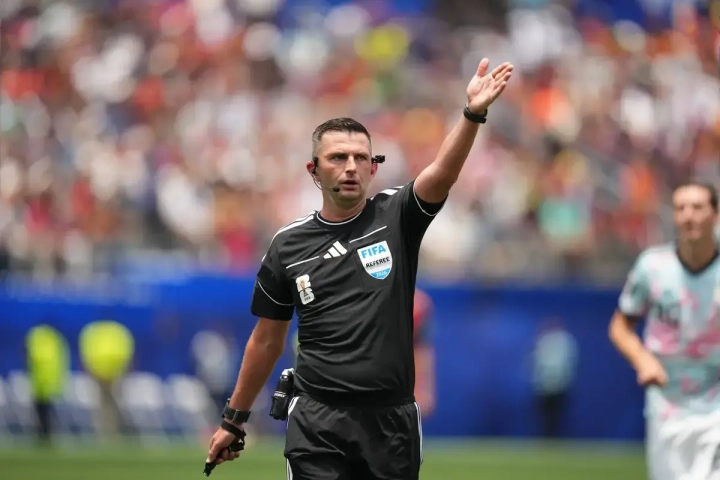
Two of English football’s most prominent figures have already packed their bags and boarded flights back to London Heathrow. Elite Premier League match officials Michael Oliver and Anthony Taylor have officially departed the 2026 World Cup camp. Their sudden exit has prompted questions from casual observers who might assume a controversy or a dip in performance was the catalyst. In reality, their departure is not the result of a scandalous error or a disciplinary breach, but rather a direct, unavoidable consequence of their own national team’s extraordinary success.
In the highly scrutinised world of international football refereeing, the advancement of your home nation spells the immediate termination of your own tournament ambitions. As we dissect the mechanics of FIFA’s stringent officiating protocols, it becomes clear why England’s pursuit of global glory necessitated the immediate withdrawal of their top domestic referees.
The Mechanics of the FIFA Refereeing Cut
To understand the departure of Oliver and Taylor, one must first examine how FIFA manages its vast officiating roster throughout a major tournament. The World Cup begins with a bloated squad of referees, assistant referees, and Video Assistant Referees assembled from across the six continental confederations. During the frantic group stages, where up to four matches are played daily, this massive pool of officials is stretched to its absolute limit, requiring immense logistical coordination.
However, as the tournament progresses into the knockout phases, the mathematical reality of the competition shifts. The number of matches decreases dramatically, while the stakes rise exponentially. By the time the tournament reaches the semi-final stage, only four matches remain on the entire schedule: the two semi-finals, the third-place play-off, and the grand final itself.
Consequently, FIFA’s refereeing committee implements a ruthless, systematic trimming of the roster. Officials who were deemed to have underperformed or made high-profile errors in earlier rounds are quietly thanked for their services and sent home. But performance is not the only metric for retention. The geopolitical landscape of the remaining teams plays a massive, overriding role in deciding who stays and who departs.
The Strict Protocols of Absolute Neutrality
FIFA operates under a doctrine of absolute, unimpeachable neutrality. The governing body is acutely aware that the global spectacle of the World Cup relies entirely on the perceived integrity of the officials. Therefore, strict conflict-of-interest regulations are enforced with uncompromising rigidity.
The most basic of these rules is obvious: a referee cannot officiate a match involving their own national team. Consequently, neither Michael Oliver nor Anthony Taylor could ever be appointed to referee England versus Argentina tonight.
However, the protocol extends much further into the realms of perceived, indirect bias. If an English referee were appointed to officiate the other semi-final, the clash between Spain and France in Dallas, it would immediately create a severe conflict of interest. Should that English referee make a controversial decision, such as issuing a red card or a suspension-inducing yellow card to a key Spanish or French player, conspiracy theories would instantly erupt. Accusations would inevitably circulate suggesting the official was subconsciously, or deliberately, weakening the opposition to give England a distinct advantage in a potential final.
To completely eliminate even the faintest whisper of conspiracy, FIFA routinely clears out officials from the nations that have reached the final four. With England, Argentina, Spain, and France making up the semi-finalists, referees holding passports from these four nations are systematically removed from the active selection pool. Their tournament is over, not because they failed, but because their compatriots succeeded.
The Paradox of Patriotism for Match Officials
This bureaucratic reality creates a fascinating, often overlooked psychological paradox for elite international referees. Like the players they share the pitch with, officials dedicate their entire professional lives to reaching the World Cup. It requires years of flawless domestic performances, gruelling physical fitness tests, and immense mental resilience to earn the prestigious FIFA badge.
For a referee, the absolute pinnacle of their career is walking out of the tunnel to officiate the World Cup Final. Yet, achieving this ultimate dream is entirely dependent on the failure of their own national team.
Historical precedent perfectly illustrates this cruel dichotomy. In 2010, the highly respected English referee Howard Webb achieved the ultimate honour of refereeing the World Cup Final between the Netherlands and Spain in Johannesburg. Webb’s appointment was made possible because the England national team, then managed by Fabio Capello, suffered a dismal campaign and were eliminated by Germany in the Round of 16.
The trend has continued consistently over the past decade. In 2014, Italy’s Nicola Rizzoli took charge of the final only after the Italian national team crashed out in the group stages. In 2018, Argentina’s Nestor Pitana blew the final whistle in Moscow, a direct consequence of Argentina’s early exit to France. Most recently, in 2022, Poland’s Szymon Marciniak was handed the whistle for the legendary final in Qatar, a path cleared by Poland’s elimination in the first knockout round.
For Oliver and Taylor, witnessing Jude Bellingham and Harry Kane guide England deep into the tournament undoubtedly elicits immense national pride. However, from a strictly professional standpoint, every English victory was another nail in the coffin of their own World Cup ambitions.
Profiling the Departed Officials
The departure of the English contingent removes two of the most experienced and battle-hardened referees from the FIFA roster. Both Oliver and Taylor are mainstays in the English Premier League, routinely tasked with managing the most volatile and high-stakes fixtures in domestic world football.
Michael Oliver, hailing from Ashington, has long been regarded as one of UEFA’s most trusted assets. Known for his calm demeanour and preference for allowing the game to flow, Oliver has built a formidable reputation on the European stage, frequently taking charge of massive UEFA Champions League knockout ties. His presence in North America was a testament to his sustained excellence, and he exits the tournament with his professional reputation firmly intact.
Anthony Taylor, from Wythenshawe, shares a similarly elite pedigree. A veteran of multiple European Championships and global tournaments, Taylor is renowned for his authoritative command of the pitch and his strict enforcement of disciplinary boundaries. His vast experience managing monumental egos and hostile crowds made him a strong candidate for the later stages of this World Cup, had the geopolitical alignment fallen in his favour.
Their exit also impacts the Video Assistant Referee operations. The neutrality protocols apply just as strictly to the officials sitting in the technology hubs as they do to the men on the grass. The English specialists who travelled to North America alongside Oliver and Taylor have also been relieved of their duties, ensuring that no English eyes are involved in the decisive technological interventions of the final matches.
The Remaining Roster: Who Takes the Whistle?
With officials from the four competing nations sidelined, FIFA’s refereeing committee is now forced to look towards neutral confederations to find the men who will oversee the climax of the 2026 World Cup.
The pressure on the remaining officials is astronomical. They must navigate the intense historical rivalry of England versus Argentina tonight, and ultimately, manage the grand finale in New Jersey. Referees from nations that have already been eliminated, perhaps an experienced official from Italy, Germany, or a highly rated representative from the Asian or CONCACAF confederations, will be entrusted with these career-defining appointments.
As Michael Oliver and Anthony Taylor touch down on British soil, they do so having fulfilled their duties with utmost professionalism. They will return to their training regimens, preparing for another gruelling season in the Premier League. While the bitter sting of missing out on a potential World Cup Final appointment may linger, it is a sacrifice they are accustomed to making.
In the grand tapestry of international football, the referees remain the silent facilitators. Their early flight home is the ultimate, quiet sacrifice required to maintain the absolute integrity of the sport. And as the English public packs into pubs and living rooms tonight, nervously awaiting kickoff in Atlanta, it is safe to say that exchanging the presence of their domestic referees for a chance at a World Cup final is a trade they would gladly make every single time.