
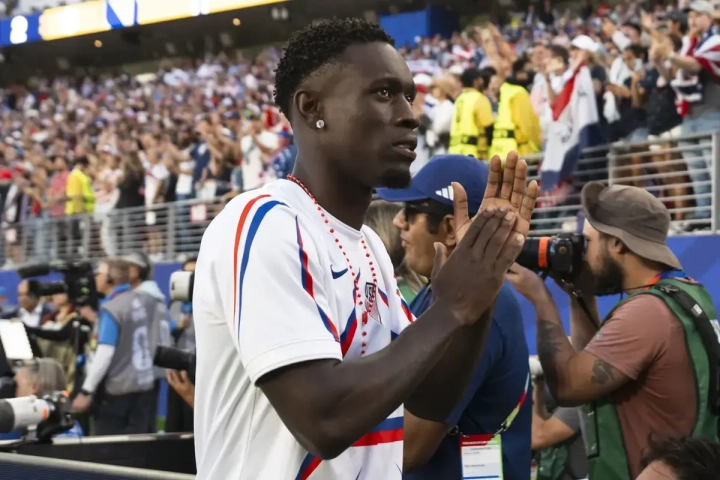
The 2026 FIFA World Cup, hosted across North America, was always destined to be a tournament of unprecedented scale and spectacle. Yet, as the competition transitions into the business end of the knockout stages, the most explosive talking point has occurred not on the pitch, but in the corridors of power. The unprecedented decision by FIFA to overturn an automatic red-card suspension for United States striker Folarin Balogun, allegedly following direct political lobbying from US President Donald Trump, has plunged the governing body into a geopolitical storm.
With the USA preparing to face Belgium in a crucial Round of 16 clash in Seattle tonight, the fallout from the ‘Balogun ruling’ has drawn furious condemnation from UEFA, the Royal Belgian Football Association, rival managers, and a host of footballing legends. As the lines between international diplomacy and sporting integrity become increasingly blurred, here is a comprehensive breakdown of the incident, the intervention, and the global outrage it has provoked.
The Incident: A Harsh Red in the Round of 32
To understand the magnitude of the controversy, one must first look back to the Round of 32. On Thursday, 2 July, the United States faced Bosnia and Herzegovina, seeking their first knockout victory at a World Cup since 2002.
Folarin Balogun, the AS Monaco striker and former England Under-21 international, had been the standout star of the USMNT’s campaign, netting two goals in the group stage. He continued his scintillating form by opening the scoring in the 45th minute. However, the match turned sour in the 64th minute. Following a seemingly innocuous collision, Balogun’s boot landed awkwardly on the upper ankle of Bosnian defender Tarik Muharemović.
Initially, Brazilian referee Raphael Claus allowed play to continue, viewing the contact as entirely accidental. But the Video Assistant Referee (VAR) intervened, advising Claus to review the pitchside monitor. Upon review, Claus shocked the stadium by brandishing a straight red card for serious foul play.
While the USA ultimately held on for a 2-0 victory, thanks to a late goal from Malik Tillman, the consensus among players, fans, and pundits was that the dismissal was incredibly harsh. Nevertheless, under standard FIFA regulations, a straight red card carries a mandatory one-match suspension, seemingly ruling Balogun out of the highly anticipated knockout clash against Belgium.
The Intervention: The ‘Trump Factor’
Under normal circumstances, the American coaching staff would have simply resigned themselves to being without their talismanic forward. However, the circumstances surrounding this World Cup are anything but normal.
In a stunning turn of events on Sunday, 5 July, FIFA formally announced that the implementation of Balogun’s one-match ban had been suspended. The revelation that followed sent shockwaves through the sporting world. According to multiple verified reports, US President Donald Trump made three separate phone calls to FIFA President Gianni Infantino beginning on Wednesday, actively lobbying the governing body to rescind the suspension.
President Trump did little to downplay his involvement. Shortly after FIFA’s announcement, he took to his Truth Social platform to publicly celebrate the verdict.
“Thank you to FIFA for doing what was right, and reversing a great injustice!” Trump wrote, effectively confirming his personal intervention in the disciplinary process.
For the American camp, the news was received with a mixture of disbelief and jubilation. US defender Chris Richards revealed that the squad initially thought the news was a product of artificial intelligence. “We weren’t quite sure if it was true or not,” Richards admitted to the press. “I think everyone knows with AI and with this and that, there can be a few question marks, but ultimately we found out through social media. It was just cool to finally get the confirmation.”
FIFA’s Rationale: Article 27 and the ‘Ronaldo Rule’
Faced with mounting scrutiny, FIFA released a statement attempting to justify the procedural legality of the reversal. The disciplinary committee cited Article 27 of the FIFA Disciplinary Code, a provision that allows the governing body to suspend the enforcement of a disciplinary sanction, provided the offence is not related to match-fixing.
As a result, Balogun’s ban has been deferred for a “probationary period of one year.” Should the 25-year-old commit another infringement of a similar nature and gravity during this timeframe, the one-match suspension will be instantly triggered alongside any new penalties.
While the overturning of a World Cup red card is extraordinarily rare, the most famous precedent being Brazil’s Garrincha in 1962, who was cleared to play in the final after a semi-final dismissal, FIFA has recently utilised Article 27 for high-profile stars. Prior to the tournament, Portugal’s Cristiano Ronaldo benefited from a similar ruling. After receiving a red card for violent conduct in a qualifier, which usually carries a strict three-match ban, FIFA issued a suspended sentence that allowed him to play in the World Cup group stages.
Despite this precedent, the blatant political pressure applied by a sitting US President has cast a long, uncomfortable shadow over FIFA’s claims of procedural independence.
The Backlash: UEFA and Belgium Draw a “Red Line”
The reaction from the European footballing establishment has been nothing short of explosive. UEFA, European football’s governing body, released a scathing official statement condemning FIFA’s decision, arguing that it fundamentally compromises the integrity of the tournament.
“Yesterday’s decision to suspend for a probationary period of a year the implementation of the one-match automatic suspension following the red card issued to the player Folarin Balogun crossed a red line,” the UEFA statement read. “A minimum automatic suspension of one match following a red card is not a discretionary option and does not require the decision of a competent body to be enacted… When the certainty of rules is no longer guaranteed by its guardians, the integrity of the game is at stake and the credibility of a competition is undermined.”
The Royal Belgian Football Association (RBFA), whose team must now face a full-strength American attack in Seattle, was left seething. Describing themselves as “astonished,” the RBFA pointed out that the ruling contradicts World Cup 2026 Circular No 16, which explicitly reaffirms the automatic nature of red-card suspensions. The Belgian federation confirmed it is exploring all legal options to safeguard the principles of fair play.
Belgium’s head coach, Rudi Garcia, was visibly furious during his pre-match press conference, employing biting sarcasm to express his disbelief. “I didn’t know that in the offices of FIFA the fifth of July was the first of April in Europe,” Garcia mocked. “I think it’s the first time in the history of the World Cup that there is this kind of decision.”
Rival Managers and Pundits Erupt
The outrage has cascaded well beyond the Belgian camp, uniting rival managers and former professionals in disbelief over the precedent being set.
England manager Thomas Tuchel, whose side has already progressed to the quarter-finals, voiced his deep unease over the regulatory chaos. “We can now debate endlessly: I think it’s not a yellow card, or a red,” Tuchel stated. “Where does this end? Where does it stop?” Norway’s head coach, Ståle Solbakken, was even more direct: “What about the next red card? Is there going to be some committee somewhere that is going to take that card away? It’s a bad, bad, bad decision that will hurt the World Cup.”
In the broadcasting studios, the condemnation was universal. Former England and Manchester United striker Wayne Rooney delivered a blistering assessment on BBC Sport. “I think it’s an absolute disgrace, I really do,” Rooney fumed. “Infantino should be ashamed of this. The sportsmanship of this game is in question here. If I’m USA’s opponent, I’d be absolutely fuming. It’s wrong in every way.”
Gary Neville echoed those sentiments on ITV, questioning the sudden implementation of an appeals process that seemingly caters only to the host nation. “It absolutely stinks, let’s be really clear,” Neville argued. “If there’s no process for it to be overturned, and then somehow FIFA, from nowhere, have decided to basically let a player play… the rules should be the same for everybody.”
Even French legend Thierry Henry, while admitting he felt the initial red card was unjust, questioned the timeline and fairness of the reversal. “Three or four days to make a decision… if you’re Belgium preparing for the game, it does change everything. Why so late?”
Conclusion: A Charged Encounter in Seattle
As the United States and Belgium prepare to walk out onto the pitch in Seattle on Monday night, the atmosphere will be electrifying and fiercely contentious. What was already a high-stakes knockout fixture has been transformed into a global referendum on sporting fairness, political interference, and FIFA’s governance.
Folarin Balogun will take the field under a microscope of unimaginable pressure, burdened not just with the hopes of a nation, but with the weight of a presidential intervention. Regardless of the final scoreline against the Belgians, the ‘Balogun ruling’ has already cemented its place as one of the most controversial and highly debated chapters in the storied history of the FIFA World Cup.