
The global governing body of football has handed down some of the most severe disciplinary sanctions in its modern history, issuing unprecedented bans to several high-profile Argentine players following the disgraceful scenes that marred the conclusion of the 2026 FIFA World Cup final.
Just one month after Spain secured their second World Cup star with a dramatic 1-0 extra-time victory over Argentina at the MetLife Stadium in New Jersey, FIFA confirmed the outcome of a comprehensive disciplinary investigation. The governing body released a statement detailing the severe repercussions for the mass brawl that erupted immediately after the final whistle, overshadowing the showpiece event of the global sporting calendar.
The most staggering penalty has been directed at veteran midfielder Leandro Paredes, who has been suspended from international duty for an extraordinary ten matches. This historic punishment reflects the gravity of the post-match violence, forcing the South American champions to navigate the immediate future without several core figures.
The Anatomy of the MetLife Melee
The tension between the two footballing heavyweights had been brewing throughout a fiercely contested 120 minutes of football. However, it was immediately following the final whistle, which confirmed Spain’s triumph via a 106th-minute strike from Ferran Torres, that the lingering animosity exploded into outright violence.
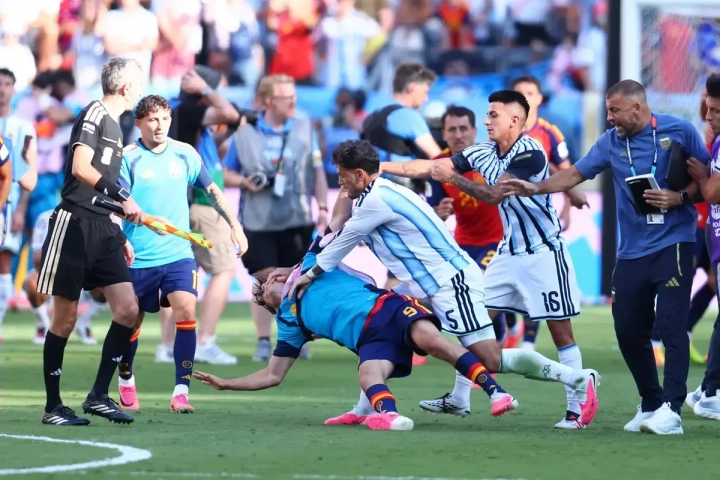
As the Spanish substitutes and coaching staff rushed onto the pitch to celebrate their momentous victory, several Argentine players entirely lost their composure. The primary instigator, according to FIFA’s findings, was Leandro Paredes. The midfielder was captured violently grabbing Spanish defender Eric García by the throat amidst the chaotic celebrations, before aggressively throwing youthful midfielder Gavi to the turf.
The situation rapidly deteriorated as further players engaged in the melee. Argentina full-back Nahuel Molina initiated his own physical altercation by striking Spain captain Rodri. The scale of the brawl required massive intervention, with Argentina head coach Lionel Scaloni forced to physically restrain his own players and drag them away from the epicentre of the conflict.
Despite no red cards being issued after the final whistle, FIFA’s disciplinary committee launched an immediate investigation the following morning. Through the use of comprehensive broadcast footage and stadium security cameras, the committee identified multiple breaches of the disciplinary code, resulting in the heavy-handed sanctions announced today.
Breakdown of FIFA Disciplinary Sanctions
The punishments issued by FIFA not only involve lengthy suspensions but also carry substantial financial penalties for both the individuals involved and the Argentinian Football Association (AFA).
| Individual / Entity | Role | Sanction | Financial Penalty |
| Leandro Paredes | Argentina Midfielder | 10-Match Ban | $90,000 USD |
| Nahuel Molina | Argentina Defender | 7-Match Ban | $90,000 USD |
| Roberto Ayala | Argentina Assistant Coach | 3-Match Ban | $30,000 USD |
| Thiago Almada | Argentina Midfielder | 1-Match Ban | $30,000 USD |
| Gavi | Spain Midfielder | 1-Match Ban | $30,000 USD |
| AFA | National Federation | Institutional Sanction | $321,000 USD |
Spain did not escape entirely unscathed, with Barcelona midfielder Gavi receiving a one-match suspension for his retaliatory involvement in the scuffle with Paredes. However, the sheer weight of the disciplinary action has fallen squarely upon the defending champions, stripping them of key personnel for upcoming international fixtures.
A Tense Build-Up: Fernández’s Dismissal
To fully comprehend the explosive release of frustration at the final whistle, one must examine the highly charged atmosphere of the match itself. Argentina had played an intensely physical game, frustrating the Spanish attack but failing to register a single shot on target throughout the initial 94 minutes of regular time.
The match pivoted dramatically in stoppage time of the second half. With the decider deadlocked at 0-0 and heading to extra time, Chelsea midfielder Enzo Fernández was dismissed for a second bookable offence. Fernández had already received a yellow card for dissent earlier in the fixture, a senseless booking that left him walking a disciplinary tightrope.
In the 92nd minute, Fernández launched into a reckless, late challenge in a desperate attempt to win a loose ball. Spain defender Pau Cubarsí arrived first, and Fernández clattered heavily into the teenager, sending him flying into the air. The referee was left with no choice but to issue a second yellow card, reducing Argentina to ten men for the entirety of extra time.
Despite fierce protests from Fernández and captain Lionel Messi, the decision stood. The physical disadvantage eventually took its toll in the 106th minute when Ferran Torres capitalised to score the winning goal, leaving a physically exhausted and emotionally drained Argentine squad to watch their crown slip away.
The Falkland Islands Banner Controversy
Beyond the shocking violence that concluded the tournament, the AFA has been heavily penalised for political demonstrations that occurred earlier in the competition. The sweeping $321,000 fine levied against the federation encompasses team misconduct, severe security breaches, and the display of discriminatory messaging.
A substantial $10,000 portion of the fine was strictly related to a banner referencing the Falkland Islands, known as the Islas Malvinas in Argentina. The banner was provocatively displayed by the Argentine players following their tense semi-final victory over England on 15 July. A further $20,000 was deducted specifically for the inappropriate conduct of Argentine supporters in the stands.
The political undertones of the semi-final fixture had already generated significant diplomatic friction. Following the victory over England, the AFA boldly announced that the date of the triumph, 15 July, would be commemorated annually as ‘National Football Teams Day’.
The display of the banner drew immediate condemnation from political figures in the United Kingdom. Business Secretary Peter Kyle publicly denounced the gesture, describing it as “entirely inappropriate” for a sporting environment. FIFA’s decision to issue a relatively minor financial penalty for the political messaging has drawn widespread scrutiny, particularly when contrasted with the governing body’s notoriously rigid stance against political symbols in previous tournaments, such as the threat of sporting sanctions over the ‘OneLove’ armbands in Qatar in 2022.
Legal Appeals and Future Ramifications
The fallout from these historic bans will severely disrupt Argentina’s immediate international schedule. Competing without Paredes for ten matches and Molina for seven will force head coach Lionel Scaloni to radically restructure his tactical approach and integrate fringe players into the starting eleven much sooner than anticipated.
The AFA has not accepted the rulings quietly. In an official communication released shortly after FIFA’s announcement, the federation confirmed that its legal department would formally “request from FIFA the grounds for the rulings that are reviewable in order to file appeals before the Appeals Committee of the governing body.”
Whether those appeals will prove successful remains to be seen, but FIFA has set a firm and unyielding precedent regarding post-match conduct on the global stage. While Spain celebrate a glorious return to the summit of world football, Argentina are left to survey the wreckage of a campaign that ultimately descended into indiscipline and disgrace. The 2026 World Cup will forever be remembered for Spain’s triumphant brilliance, but equally, it will be defined by the chaotic and violent demise of the defending champions.