
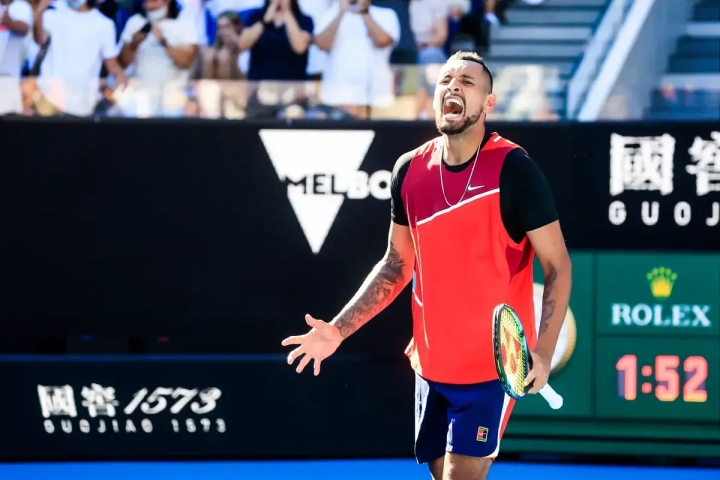
The turbulent, brilliant, and invariably controversial career of Nick Kyrgios has reached its most severe nadir yet. On Wednesday, the International Tennis Integrity Agency (ITIA) officially announced that the 31-year-old Australian has been provisionally suspended from all forms of professional tennis after testing positive for a metabolite of cocaine.
The news, dropping like a bombshell on the international sporting community, marks a devastating setback for a player who, despite his immense natural talent, has repeatedly clashed with the sport’s governing bodies. For Kyrgios, the failed anti-doping test not only halts his latest comeback attempt but raises profound questions about whether one of tennis’s greatest modern enigmas has stepped onto a professional court for the final time.
The Details of the Violation
According to the official statement released by the ITIA, the positive finding originates from an in-competition test conducted on 22 June 2026. At the time, Kyrgios was competing at the ATP 250 event in Mallorca, a tournament serving as a warm-up for the short grass-court season.
On 17 July 2026, a World Anti-Doping Agency (WADA)-accredited laboratory confirmed the presence of benzoylecgonine, a central metabolite of cocaine, in the Australian’s sample. Because cocaine is strictly classified as a stimulant and a substance of abuse on the WADA Prohibited List, a provisional suspension is mandatory under the sport’s anti-doping regulations.
“Because of the nature of the substance, a provisional suspension is mandatory and has been in place since 4 August 2026,” the ITIA confirmed in their public release. The governing body outlined the absolute nature of the ban: while provisionally suspended, Kyrgios is explicitly prohibited from playing in, coaching at, or even attending any event organised or sanctioned by World Tennis, the WTA, the ATP, the Grand Slams, or any national tennis association.
While the former world number 13 retains the right to appeal the provisional suspension before an independent tribunal, the ITIA noted that he has not submitted any such legal challenge to date.
A Public Confession: “I Made a Huge Mistake”
Unlike many high-profile doping cases within elite sport, which are frequently met with immediate legal challenges, claims of contaminated supplements, or stringent denials, Kyrgios opted for immediate, unvarnished public contrition. Taking to his Instagram account shortly after the ITIA’s announcement, the Australian issued a deeply personal apology to his millions of followers.
“I wanted you to hear this from me first,” Kyrgios wrote. “I recently failed a drug test in Mallorca after testing positive for cocaine. I made a huge mistake and I take full responsibility for it.”
The apology extended beyond his immediate circle, reflecting an awareness of his immense influence as a polarising but undeniable star of the sport. “I’m sorry to my fans, my family, my sponsors and everyone close to me. Above all, I’m sorry to the kids who follow me. I know the example this sets and I’m deeply disappointed in myself.”
Crucially, Kyrgios offered context for his actions, painting a sombre picture of an athlete grappling with the physical and psychological toll of a fading career. Over the past few years, the Australian has been plagued by severe knee and wrist injuries, drastically limiting his time on the ATP Tour and forcing prolonged, frustrating absences from Grand Slam competition.
“I do want to give some context about where I’ve been. The last couple of years of injuries have taken a huge toll on me, both physically and mentally,” he explained to his followers. “My body hasn’t been able to do what my mind expects it to do, and coming to terms with being near the end of my career has been harder than I ever imagined. I’ve always said I didn’t choose tennis, tennis chose me. But letting go of something that has been my whole life is one of the hardest things I’ve ever had to face. At times I’ve felt helpless and alone.”
A Track Record of Tumult
While a substance abuse violation constitutes an unprecedented chapter in Kyrgios’ disciplinary file, the Australian is no stranger to the sport’s punitive mechanisms. His decade-long tenure on the ATP Tour has been defined as much by his breathtaking shot-making and thunderous serve as by his combustible temperament.
His track record is littered with hefty fines, suspended bans, and explosive altercations that have continually divided the tennis establishment. For every thrilling run, most notably his magical journey to the 2022 Wimbledon men’s singles final, where he ultimately lost to Novak Djokovic, there has been a corresponding meltdown that drew global condemnation.
The first major fracture in his professional conduct occurred in 2015 during a match against Stan Wawrinka in Montreal. Courtside microphones captured Kyrgios making a deeply offensive, unprovoked remark regarding Wawrinka’s girlfriend, resulting in widespread outrage, a $10,000 fine, and a suspended 28-day ban from the ATP.
A year later, at the 2016 Shanghai Masters, the Australian was cited for “lack of best efforts”, colloquially known as tanking, during a match against Mischa Zverev. Kyrgios clashed with spectators, served softly over the net without engaging in the point, and walked off the court before returns had even landed. The ATP handed down an eight-week suspension, which was later reduced to three weeks upon his agreement to consult a sports psychologist.
Perhaps his most infamous meltdown occurred at the 2019 Cincinnati Masters. During a second-round match, Kyrgios engaged in a sustained, vitriolic tirade against chair umpire Fergus Murphy, culminating in the Australian leaving the court without permission to smash two rackets in a stadium corridor, before appearing to spit in the direction of the official. The immediate aftermath saw a staggering $113,000 fine. Following a subsequent investigation into a pattern of aggravated behaviour, the ATP imposed an additional 16-week suspended ban and a further $25,000 penalty, placing him under a rigorous probationary period.
Major Disciplinary Actions Against Nick Kyrgios
The table below outlines some of the most significant disciplinary actions levied against Kyrgios prior to his current anti-doping suspension:
| Year | Tournament | Offence | Sanction |
| 2015 | Montreal Masters | Unsportsmanlike conduct (derogatory comment towards Stan Wawrinka). | $10,000 fine and a suspended 28-day ban. |
| 2016 | Shanghai Masters | “Lack of best efforts” (tanking) and verbally abusing a spectator. | 8-week suspension (reduced to 3 weeks), $25,000 initial fine. |
| 2019 | Italian Open | Unsportsmanlike conduct (kicking a bottle, throwing a chair onto the court). | Defaulted from the tournament, stripped of ranking points/prize money, €20,000 fine. |
| 2019 | Cincinnati Masters | Verbal abuse of an official, leaving court without permission, racquet abuse. | $113,000 immediate fine; later issued a 16-week suspended ban and further $25,000 fine. |
| 2022 | Wimbledon | Spitting towards a spectator (Round 1); swearing (Round 3 vs. Stefanos Tsitsipas). | Combined $14,000 in fines across two separate incidents. |
| 2026 | Mallorca Championships | Positive anti-doping test for cocaine metabolite. | Provisional suspension pending independent tribunal. |
The Twilight of an Enigma
The tragic duality of Nick Kyrgios has always been the immense gulf between his natural ability and his professional application. When fully engaged, his blend of raw power, delicate touch, and audacious showmanship has made him one of the most compelling box-office attractions in modern tennis. He has consistently packed stadiums around the world, bringing a vital, youthful, and raucous energy to a sport that often clings rigidly to tradition and decorum. Within Australia, he generated headlines and carried the burden of public expectation in a manner completely alien to the quiet, stoic legacy of players like Ashleigh Barty or Alex de Minaur.
Yet, this latest suspension threatens to permanently overshadow those brilliant flashes of sporting genius. A provisional suspension for a recreational drug violation carries a heavy, inescapable stigma, particularly within an athletic framework that prides itself on stringent anti-doping protocols.
The exact length of a potential definitive ban will ultimately be determined by an independent tribunal. This panel will weigh complex mitigating factors such as intent, the out-of-competition context of his struggles, and his immediate confession. Under the World Anti-Doping Code, the standard sanction for a substance of abuse can be significantly reduced if the athlete can prove the ingestion occurred out of competition and was unrelated to sports performance. Nevertheless, any period of mandatory exile could prove fatal to the 31-year-old’s active playing career.
By his own admission, the gruelling rehabilitation from chronic injuries had already pushed him to the absolute brink of retirement. This positive test, coupled with a mandated hiatus from the professional ecosystem, may force the issue entirely.
For the international tennis establishment, the saga of Nick Kyrgios has always been a complex management exercise, constantly balancing the immense commercial value of his charisma against the persistent headaches of his conduct. Now, as the sport processes the ITIA’s sobering announcement, that headache has escalated into a profound personal tragedy. The Australian leaves behind an immediate legacy of what might have been: a generational talent who routinely conquered his opponents on the court, but ultimately failed to conquer the demons existing off it.
As the disciplinary process unfolds over the coming weeks, the tennis world will await the formal tribunal verdict. However, given the heartbreaking tone of his public apology and the devastating reality of his physical decline, the sport may have already witnessed the final, tumultuous chapter of Nick Kyrgios’ professional career.