
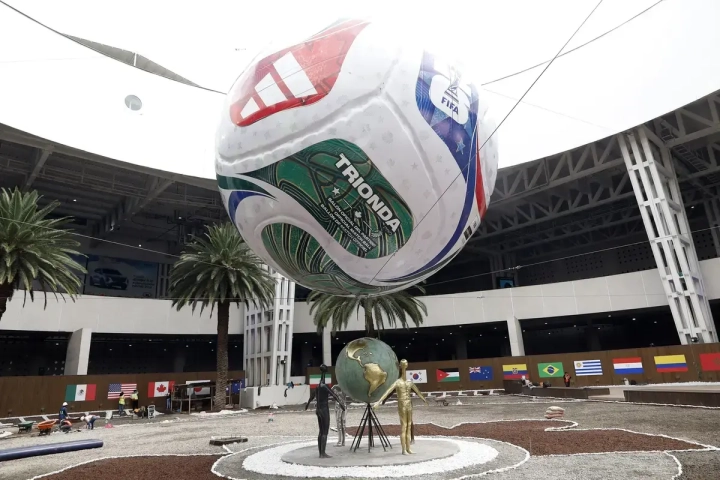
As the 2026 FIFA World Cup approaches, the focus is shifting not just to the expanded 48-team grid, but to the very object at the centre of the pitch. Adidas has officially unveiled Trionda, the official match ball for the tournament hosted across Canada, Mexico, and the United States.
Named after the Spanish translation for “three waves,” the Trionda is a sophisticated marriage of cultural symbolism, aerodynamic engineering, and cutting-edge data tracking. However, scientific testing suggests that its advanced design might alter how the game is played on the grass, particularly for long-range shooters and goalkeepers.
A Tribute to Three Hosts
The aesthetic and structural makeup of the Trionda directly celebrates the historic three-nation collaboration:
- Colour Palette: A vibrant red, green, and blue colour scheme pays homage to the national colours of Canada, Mexico, and the U.S.
- Four-Panel Geometry: Breaking away from traditional multi-panel configurations, the ball features a brand-new, fluid four-panel construction. These panels converge to form a prominent triangle at the centre, symbolizing the union of the host nations.
- National Iconography: Closer inspection reveals embossed emblems embedded into the surface texture, the Canadian maple leaf, the Mexican eagle, and the American star, alongside gold accents honouring the World Cup Trophy.
The Physics Twist: More Control, Less Distance
While the ball is designed to elevate grip in wet or humid conditions, independent aerodynamic testing reveals an intriguing trade-off in flight behaviour.
Wind-tunnel experiments conducted at the University of Tsukuba in Japan, led by sports physics researchers including John Eric Goff, indicate that the Trionda improves upon the unpredictable trajectories of past tournament balls, but it may punish extreme distance.
The Drag Crisis Solved
Ever since the controversial, ultra-smooth Jabulani ball of the 2010 World Cup caused erratic dipping, manufacturers have added surface texture to stabilize flight. The Trionda features intentionally deep seams and three deep grooves per panel. This added surface roughness successfully pushes the “drag crisis” to exceptionally low speeds, ensuring the ball maintains a highly predictable, clean flight path as it slows down.
The Distance Trade-Off
However, that same roughness yields a higher drag coefficient at top speeds. According to the research team’s simulations, when a ball is struck with maximum force, such as a goalkeeper’s long clearance, a defender’s switching cross, or a blistering long-range shot, it will experience more air resistance early in its flight. As a result, the trajectories of long kicks are projected to be a few meters shorter than those of its recent predecessors.
The Connected Ball: Powered by a Charger
Beyond its aerodynamic profile, the Trionda serves as a live data-broadcasting device. For the 2026 tournament, the concept of the “connected ball” has been significantly upgraded to integrate with modern officiating demands.
- The 500Hz Motion Sensor: Suspended at the centre of the ball is an Inertial Measurement Unit (IMU) sensor chip. It captures granular movement and acceleration data 500 times per second, mapping exactly what the ball is doing in a three-dimensional space.
- Real-Time VAR Sync: Every touch, deflection, and pass is instantly transmitted to the Video Assistant Referee (VAR) hub. This data feeds directly into FIFA’s revamped semi-automated offside technology, which can now alert officials when a player is offside by a margin as small as 10 centimetres.
- Battery Dependency: Because of this continuous broadcasting power, the Trionda must be physically charged before games. A 90-minute plug-in charge provides roughly six hours of active battery life on the pitch.
Integrating with AI Avatars
The data collected by the Trionda will work in tandem with a stadium-wide camera network and new AI-enabled 3D player avatars. Players will be digitally scanned to create precise 3D body models, allowing the automated system to track body parts accurately during crowded or fast-moving sequences. This ensures that when an offside decision is rendered, fans in the stadium and TV viewers worldwide are shown a highly realistic, immediate visual representation of the call.