
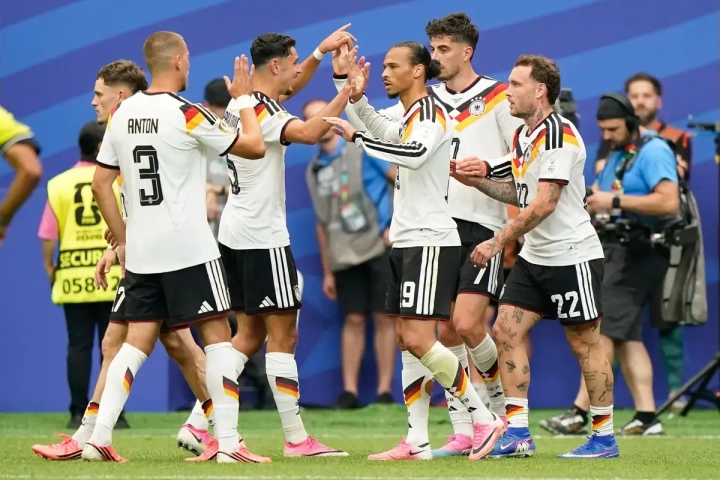
The 2026 FIFA World Cup officially burst into life for Group E on Sunday evening as four-time champions Germany dismantled tournament debutants Curaçao in a resounding 7-1 victory. Staged beneath the imposing architecture of the Houston Stadium in Texas, the fixture commenced at exactly 18:00 BST on 14 June 2026. For Julian Nagelsmann’s highly fancied European outfit, the dominant performance served as a menacing warning to their title rivals, comprehensively banishing the lingering ghosts of their recent opening-day tournament struggles. Yet, despite the entirely one-sided final scoreline, the Caribbean islanders ensured they left an indelible mark on the global showpiece, producing a moment of historic defiance that will be celebrated for generations back home.
Tactical Setups and the Opening Exchanges
Entering the sweltering Texas heat, the tactical disparity between the two nations was immediately evident. Nagelsmann deployed a fluid, possession-heavy 4-2-3-1 formation, instructing his dynamic attacking midfield trio of Florian Wirtz, Jamal Musiala, and Leroy Sané to relentlessly interchange positions behind Arsenal forward Kai Havertz. Conversely, Dick Advocaat, who officially etched his name into the record books as the oldest manager in World Cup history at 78 years of age, tasked his Curaçao side with maintaining a rigid, compact defensive block, heavily reliant on the counter-attacking outlets of Sontje Hansen and Jürgen Locadia.
The sheer weight of German pressure yielded dividends almost instantaneously. A mere six minutes into the contest, the European heavyweights breached the Caribbean defence. Collecting a precise, perfectly weighted pass from Wirtz on the edge of the penalty area, midfielder Felix Nmecha expertly shifted his body weight before unleashing a sublime curling strike that nestled into the far corner, entirely evading the desperate dive of goalkeeper Eloy Room. At that juncture, the overwhelming expectation inside the stadium was that the floodgates would immediately open, subjecting the heavy underdogs to an arduous and punishing evening.
A Historic Caribbean Equaliser
However, football possesses an unparalleled capacity for romance, and the smallest nation to ever qualify for a men’s World Cup finals, boasting a population of just 160,000, promptly delivered a moment of sheer sporting magic. In the 21st minute, deeply against the established run of play, Curaçao orchestrated a swift transition through the central channel. A loose, bouncing ball fortuitously fell into the path of Livano Comenencia. The midfielder struck it with venom, and a wicked deflection off the retreating German defensive line entirely wrong-footed veteran goalkeeper Manuel Neuer.
As the ball trickled over the line, the section of travelling supporters affectionately known as the Blue Wave erupted into absolute delirium. Comenencia’s strike marked Curaçao’s first-ever goal at a major global tournament, simultaneously serving as a stark reminder to the German backline that any lapse in concentration would be ruthlessly punished. For a fleeting fifteen-minute period, the island nation stood toe-to-toe with one of the sport’s traditional aristocratic powers.
Restoring the Natural Order
The shock equaliser visibly stung the heavily favoured Germans, prompting an immediate intensification of their attacking efforts. Dictating the tempo with an impressive 71% possession share throughout the first half, the passing networks orchestrated by Aleksandar Pavlović and Nmecha began to pull the exhausted Curaçao defenders completely out of position. The inevitable breakthrough to restore their advantage arrived in the 38th minute via a traditional route. Capitalising on a momentary lapse in marking from Armando Obispo, central defender Nico Schlotterbeck rose highest to meet a pinpoint corner delivery, powerfully heading the ball downward and back across the goal to make it 2-1.
As the interval rapidly approached, the European side delivered a psychologically devastating blow to their valiant opponents. Driving aggressively into the penalty area, the influential Nmecha was clumsily brought down by a lunging tackle from Riechedly Bazoer, leaving the match official with absolutely no alternative but to point to the penalty spot. Assuming the immense responsibility, Havertz stepped up in the fifth minute of first-half stoppage time (45+5′), coolly sending Room the wrong way to establish a commanding two-goal cushion just before the referee blew for half-time.
The Second-Half Onslaught
Any lingering hopes of a miraculous second-half Caribbean resurgence were ruthlessly extinguished mere seconds after the restart. Just 69 seconds into the second period (47′), the sheer quality of the German squad was vividly showcased. Collecting a breathtakingly precise, defence-splitting pass from Joshua Kimmich on the right flank, Musiala accelerated into the penalty box. Displaying remarkable composure and elite balance, the young playmaker slotted a low, driven finish perfectly into the far bottom corner from a tight angle.
With the result now entirely beyond doubt, Nagelsmann utilised his formidable substitutes bench to devastating effect, completely suffocating the tiring opposition. The introduction of Deniz Undav in the 63rd minute added a fresh, lethal dimension to the attacking line. Five minutes later (68′), Undav made an immediate impact, intelligently flicking a pass from Wirtz into the path of the overlapping Nathaniel Brown. Making his highly anticipated World Cup debut, the full-back connected sweetly with a volley, hooking the ball decisively into the bottom corner to stretch the lead to 5-1.
The relentless waves of high-speed attacks continued to crash against the fractured Curaçao defence. Undav transformed from provider to goalscorer in the 78th minute, capitalising on further exhaustion within the Caribbean ranks to stroke home his team’s sixth of the evening. The spectacular rout was ultimately completed in the dying embers of the match. Latching onto a loose ball forced by a high press from substitute Leon Goretzka, Undav unselfishly squared the ball to Havertz in the 88th minute. The Arsenal forward took a single touch to set himself before clipping a deft finish over the advancing goalkeeper, sealing a resounding 7-1 victory and cementing his status as the undisputed Player of the Match.
Record Breakers and Managerial Reflections
Beyond the spectacular array of goals, the fixture was notable for several remarkable individual milestones. Taking his place between the posts, Neuer officially became the oldest German player to ever feature at a major international tournament. At exactly 40 years and 79 days old, the legendary shot-stopper surpassed the long-standing record previously held by Lothar Matthäus, further solidifying his legacy as one of the greatest goalkeepers of his generation.
Despite conceding a slightly alarming goal to the tournament debutants, Nagelsmann appeared visibly satisfied with the comprehensive nature of the response. “We settled early, and the reaction to their equaliser was exactly what I demanded from the squad,” the manager stated in his post-match briefing. “To score seven goals in a World Cup opening fixture requires immense focus and ruthless execution. We displayed excellent balance in attack today.”
Conversely, Advocaat remained deeply pragmatic regarding the immense gulf in quality, choosing instead to focus entirely on the historic magnitude of his team’s solitary goal. “We played against a team capable of winning this entire tournament,” the veteran Dutch tactician conceded. “For twenty minutes, we made them worry, and we scored a goal that our country will absolutely never forget. The physical toll in the second half was simply too much, but I am immensely proud of the undeniable fight my players showed on the world’s biggest stage.”
Tournament Implications and Look Ahead
This emphatic result immediately catapults Germany to the summit of Group E, providing them with a formidable goal-difference advantage that could prove utterly crucial as the tournament progresses. Their attacking prowess has unequivocally sent a terrifying message to the rest of the expanded 48-team field. They will now turn their immediate attention to a significantly sterner test against a highly physical Ivory Coast outfit, fully aware that another victory would virtually guarantee their progression to the coveted knockout stages.
For Curaçao, the harsh reality of elite-level international football has been thoroughly laid bare. However, their primary objective of making a tangible impact on the global stage was successfully achieved the moment Comenencia’s deflected strike rippled the net. They must now rapidly regroup and recover their physical conditioning ahead of a crucial, must-win encounter against South American challengers Ecuador. If they can defensively replicate their spirited opening half-hour against the Germans, the Caribbean fairy tale may yet have another surprising chapter waiting to be written.