
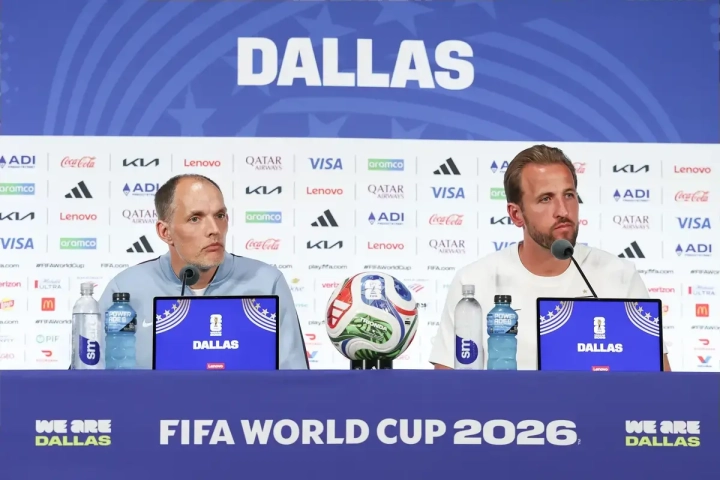
When England step out onto the pitch in Dallas tonight to launch their 2026 FIFA World Cup campaign, the temperature inside the climate-controlled stadium will be a comfortable 21°C. Outside, however, the heat surrounding Thomas Tuchel’s tactical decisions is already reaching a boiling point.
The narrative dominating the English press for the past month has not been about the players on the plane, but those left on the tarmac. The unprecedented exclusion of elite technical creators like Phil Foden, Cole Palmer, and Trent Alexander-Arnold sent shockwaves through the footballing landscape. Yet, as the Three Lions prepare to face Croatia in their Group L opener, the method behind Tuchel’s apparent madness is about to be put to the ultimate test.
England have fundamentally traded intricate, slow-build possession for lethal, direct transition speed. Against a seasoned Croatian side, this is not a gamble; it is a calculated tactical execution.
The Death of the Slow Build-Up
For years, England’s major tournament downfall has been a tendency to become bogged down in the middle third. Against technically superior, possession-heavy midfields, something Croatia has historically weaponised against the Three Lions, England have often found themselves trapped in a cycle of sideways passing.
Thomas Tuchel’s assessment of international football is heavily pragmatic. Tournaments are rarely won by the team that completes the most passes; they are won by teams that exploit structural transitions and punish defensive high lines. By leaving behind the likes of Foden and Palmer, players who thrive by drifting into central half-spaces and operating as primary playmakers, Tuchel has deliberately bypassed the congested midfield battleground.
Instead, the German tactician has built a squad designed to stretch the pitch to its absolute limits.
The Protagonists: Saka and Gordon
The core of England’s attacking philosophy tonight rests on the shoulders of Bukayo Saka and Anthony Gordon. Both wingers represent the archetypal profile Tuchel demands for this system: explosive pace, high defensive work rates, and a willingness to stay chalk-on-the-boots wide.
- Bukayo Saka: Operating on the right, Saka’s role is to pin back the Croatian left flank. Rather than cutting inside early to act as a secondary number 10, Tuchel requires Saka to hold his width, forcing the Croatian defensive block to stretch horizontally and creating isolated 1v1 matchups.
- Anthony Gordon: On the left, Gordon provides pure, unadulterated verticality. His elite acceleration and relentless pressing metrics make him a nightmare for aging full-backs. When England turn over possession deep in their own half, Gordon is the designated out-ball, the player tasked with sprinting into the channels behind the Croatian defence before they can successfully reorganise.
By deploying pure wingers over inverted playmakers, England ensures that whenever the ball is won back, there is an immediate, high-speed avenue of attack.
The Central Engine: Bellingham and Kane
This shift to wide, vertical pace profoundly alters the roles of Jude Bellingham and Harry Kane.
Without multiple playmakers crowding the central zones, Bellingham has exclusive ownership of the number 10 space. This allows the Real Madrid star to operate as a driving force rather than a static creator. When Saka or Gordon stretch the opposition defence out wide, it creates gaping central corridors for Bellingham to exploit with his trademark late, surging runs into the penalty area.
Similarly, Harry Kane’s evolution into a hybrid centre-forward fits this blueprint flawlessly. Against Croatia, expect to see the England captain dropping deeper into the midfield, drawing out opposition centre-backs. In previous setups, Kane dropping deep meant he was combining with Foden or Palmer in front of the defensive line. Tonight, when Kane drops, he will be looking to immediately spray long, diagonal passes into the vast swathes of space vacated for Gordon and Saka to sprint onto.
The Croatian Litmus Test
Croatia presents the perfect litmus test for this newly engineered, high-octane England. They are a team defined by their ability to control the tempo, dictate the ball, and suffocate teams through patient, structured possession. If England attempt to beat Croatia at their own game in the midfield, they risk falling into a familiar trap.
Tuchel’s strategy is a direct counter-measure. England will likely allow Croatia to hold the ball in non-threatening areas, maintaining a solid, aggressive mid-block. But the moment an interception is made by Declan Rice or Elliot Anderson in the engine room, the transition will be immediate. It will be violent, vertical, and devastatingly quick.
High Stakes in Texas
Leaving out some of the Premier League’s most naturally gifted footballers is a burden Thomas Tuchel has willingly placed squarely on his own shoulders. If England’s rapid transitions fail to click, or if they find themselves struggling to break down a deep Croatian block without a natural lock-picker like Foden or Palmer, the backlash will be swift and merciless.
But if Saka and Gordon run riot in Dallas tonight, tearing through the Croatian lines with ruthless efficiency, Tuchel’s bold blueprint will be entirely vindicated. Pace, not possession, is England’s new currency. Tonight, we find out exactly what it’s worth.