
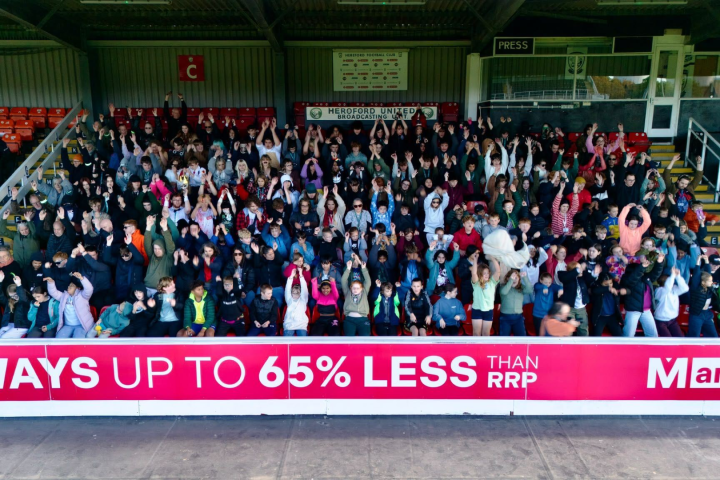
An intergenerational crowd of 200 people united at Hereford FC to create live artwork with pocket sized micro:bit computers, celebrating a decade of inspiring millions to create with technology.
The Micro:bit Educational Foundation today marked the 10th anniversary of the BBC micro:bit with a celebration of community and creativity, bringing together an intergenerational crowd of 200 people to transform a football stand into a giant, live digital Mexican wave.
Gathering in the stands at Hereford Football Club, primary school pupils, including students from Royal National College for the Blind, educators, and community members joined forces for a one off participatory artwork titled ‘micro:wave’.
Reimagining the classic Mexican wave for the digital age, each participant held a micro:bit programmed to communicate wirelessly via radio. As radio signals passed between the devices, participants responded in real time to audio cues, visual prompts and vibration for participants who are blind and have low vision, creating a synchronised ripple of participants’ movement across the football stand.
The movement patterns were co-created by local young people during workshops led by artist and Micro:bit Educational Foundation Programme Manager Dr Emma Posey as part of we:create, a project exploring creativity and participatory art.
Dr Emma Posey said: “Marking 10 years of the micro:bit by bringing generations together has been truly special. Seeing primary pupils and older community members standing side by side in the stand, using code to spark this live digital Mexican wave, shows just how accessible and creative technology can be. It is a brilliant demonstration of what happens when you empower an entire community to create art together.”
The landmark event marks a decade of global impact since the micro:bit first launched across the UK in 2016, when up to one million free devices were distributed to Year 7 schoolchildren. Over the past ten years, the Foundation has helped 73.5 million young people across more than 85 countries build essential digital skills.
Gareth Stockdale, CEO of the Micro:bit Educational Foundation, said: “Marking ten years of the micro:bit with this incredible digital wave is a proud milestone for all of us. Over the past decade, our goal has been to inspire children to move from simply consuming technology to understanding, questioning, and creating with it.
“Today’s celebration at Hereford FC captured the true spirit of physical computing. By bringing generations together to build something fun and tangible, we’re showing that technology can bring communities together, and that the micro:bit continues to equip young people with the foundational skills, creativity, and confidence they need to thrive as technology evolves.”
The we:create project, hosted by Hereford FC, was developed in collaboration with Dr Sam Tygier and Lizzie Salmon from the Science and Technology Facilities Council (STFC). Other collaborators include Hereford College of Arts (HCA), Royal National College for the Blind (RNC), Sidney Nolan Trust, and pupils from Lord Scudamore Academy, alongside local community groups. We are pleased to acknowledge grant support from Herefordshire Community Foundation.
The milestone comes as the Foundation sets its sights on reaching 100 million young people worldwide learning with the BBC micro:bit by the end of 2028. Following the event, the team is developing an open source community toolkit so schools and community groups across the UK and internationally can use the micro:bit’s radio capabilities to launch their own participatory art projects.
For more information on the Micro:bit Educational Foundation, visit www.microbit.org.