
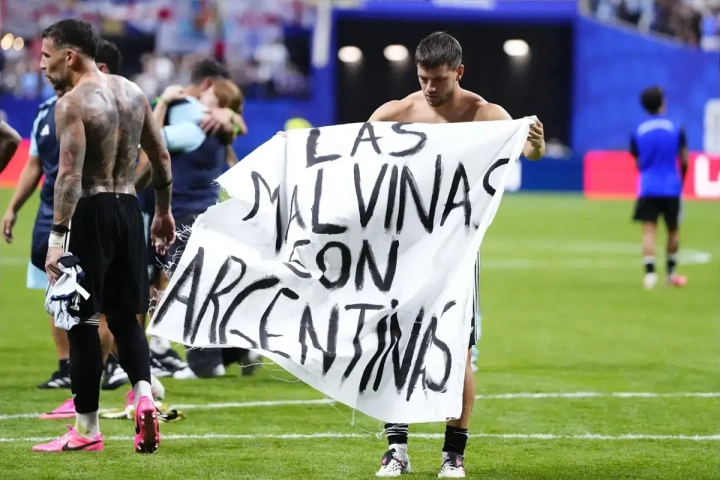
The overriding narrative of Wednesday evening at the Atlanta Stadium was supposed to be one of pure footballing drama. Following a breathtaking FIFA World Cup semi-final that saw Argentina shatter English dreams with two late strikes to secure a 2-1 victory, the immediate aftermath has instead been swallowed by a geopolitical storm. As the South American champions celebrated their progression to a second consecutive World Cup final, players produced and displayed a banner reading “Las Malvinas son Argentinas”, translating directly to “The Falkland Islands are Argentinian.”
The highly provocative display has sparked international outrage and cast a political shadow over the tournament’s climax. Despite blatant breaches of the governing body’s strict code of conduct regarding stadium messaging, FIFA has yet to officially open a disciplinary investigation. However, with political pressure mounting rapidly across the United Kingdom and global media demanding accountability, the question of how FIFA will ultimately respond, and whether Argentina could face unprecedented sporting sanctions ahead of Sunday’s showpiece final, has become the defining talking point of the tournament.
The Incident at Mercedes-Benz Stadium
Before the controversy erupted, the capacity crowd in Georgia had been treated to a remarkably tense, attritional encounter. Thomas Tuchel’s England side had dared to dream of a first World Cup final appearance since 1966 when Anthony Gordon broke the deadlock in the 55th minute. The Three Lions defended their slender advantage with immense desperation, but the reigning champions demonstrated their pedigree in the dying moments. Chelsea midfielder Enzo Fernández produced a crucial equaliser in the 85th minute, before Inter Milan talisman Lautaro Martínez broke English hearts with a dramatic stoppage-time winner to secure a 2-1 victory.
As the final whistle blew, the emotional release from the Argentine camp was palpable. Yet, during the customary lap of honour, the celebrations transitioned from sporting jubilation into explicit political posturing. Players paraded the “Las Malvinas son Argentinas” banner across the pitch, ensuring it was heavily photographed and broadcast to hundreds of millions watching around the globe.
The move was in direct defiance of the pre-match tone set by their own manager. In his press conferences leading up to the semi-final, Argentina head coach Lionel Scaloni had explicitly stated that he did not want the fixture to become entangled in the historical conflict over the British overseas territory. Scaloni had urged the media and supporters to focus entirely on the football, a directive that his own squad ultimately ignored in the heat of their victory.
The Geopolitical Context and Escalation
If the on-pitch display breached the boundaries of sporting neutrality, the subsequent reactions from the Argentine political establishment entirely obliterated them. The incident was not merely brushed off as heat-of-the-moment exuberance; it was actively championed by high-ranking government officials in Buenos Aires.
Argentina’s vice-president, Victoria Villarruel, weaponised the fixture in the build-up, taking to social media to describe England as “invaders” and “usurping pirates.” Following the full-time whistle, Villarruel doubled down on her rhetoric. She tweeted a celebratory message asserting that “it wasn’t just another match,” accompanying her inflammatory words with a photograph of the national team holding the contentious banner and a video appearing to feature Argentine military personnel.
The political tensions lingering between Argentina and Great Britain over the Falkland Islands remain incredibly raw. The sovereignty dispute violently boiled over into a short but devastating conflict in 1982, claiming the lives of 649 Argentine military personnel, 255 British servicemen, and three civilian islanders. Argentina has repeatedly and persistently claimed sovereignty over the territory, despite the islands being situated approximately 8,000 miles from Britain and roughly 300 miles from the South American mainland. In the eyes of the British government and the islanders themselves, the sovereignty issue is entirely settled. Consequently, introducing such a sensitive, unresolved diplomatic dispute onto the pitch of a World Cup semi-final was guaranteed to provoke a severe backlash.
FIFA’s Code of Conduct and Present Inaction
The central issue now rests squarely on the shoulders of FIFA, an organisation that has historically prided itself on enforcing a strict separation between global politics and the beautiful game. The governing body’s established code of conduct is unequivocally clear on the matter. It expressly prohibits the introduction or display of “banners, flags, flyers, apparel and other paraphernalia that are of a political, offensive, and/or discriminatory nature” inside any of its sanctioned stadiums.
By taking a banner explicitly claiming ownership of a disputed territory and displaying it to the global media, the Argentine players have undeniably flouted these regulations. However, as of Thursday morning, FIFA has maintained a conspicuous silence. No official investigation has been formally launched, a reality that has only served to fuel frustration among English commentators and political figures who are demanding immediate disciplinary action.
This hesitation places FIFA in a precarious position. Failing to act risks setting a dangerous precedent, essentially giving teams carte blanche to utilise the World Cup platform for geopolitical messaging. Conversely, initiating a high-profile disciplinary probe just days before the final risks overshadowing the climax of their flagship tournament.
Could Argentina Face a Ban?
In the vacuum of official action, wild speculation has flourished. Social media platforms and sensationalist outlets have questioned whether Argentina could face catastrophic sporting sanctions, such as point deductions, match annulments, or even being banned from competing in the upcoming final against Spain.
A thorough analysis of FIFA’s legal framework and historical precedent definitively dismisses these extreme scenarios. While FIFA possesses the theoretical power to suspend teams or players, implementing a tournament ban for a political banner would represent an unprecedented and disproportionate escalation. The governing body has consistently treated political displays as administrative misconduct rather than sporting offences, reserving match bans and tournament expulsions for incidents involving severe, targeted discrimination, extreme physical violence, or systematic corruption.
To understand the likely outcome, should FIFA eventually bow to the mounting pressure and open an investigation, one only needs to look back twelve years. Ahead of the 2014 World Cup in Brazil, the Argentine national team hosted Slovenia for a warm-up friendly in Buenos Aires. Before kickoff, the entire starting lineup stood behind a banner bearing the exact same phrase: “Las Malvinas son Argentinas.”
Following that incident, FIFA did open disciplinary proceedings against the Argentine Football Association (AFA). However, the punishment handed down was not a sporting ban; it was a financial penalty. The AFA was fined 30,000 Swiss francs (approximately £20,000 at the time) and issued an official reprimand for breaching regulations regarding political action and team misconduct.
Therefore, the prospect of Lionel Messi, Lautaro Martínez, or Enzo Fernández being suspended from the final at the New York New Jersey Stadium is vanishingly small. If an investigation is eventually triggered, the most realistic consequence is a heavily amplified financial penalty against the AFA, reflecting the severe profile of a World Cup semi-final compared to a pre-tournament friendly.
Looking Ahead to New York
As the dust begins to settle on a frantic night in Atlanta, the focus for Lionel Scaloni’s squad must rapidly shift towards the immense tactical challenge awaiting them on the East Coast. Spain, who booked their place in the final with a clinical 2-0 victory over France, represent a formidable final hurdle in Argentina’s quest to retain their global crown.
Yet, the fallout from Wednesday’s post-match celebrations ensures that the build-up to Sunday’s showpiece will be fraught with off-pitch tension. The Argentine players have placed themselves directly in the centre of a diplomatic storm, and the world is currently waiting to see if FIFA will summon the authority to intervene, or if the governing body will simply look the other way in the name of preserving the spectacle. Until a formal decision is made, the controversy surrounding the Falklands banner will continue to dominate the headlines, serving as a stark reminder that in the hyper-connected world of modern sports, the football pitch is never truly insulated from the complexities of global politics.