
The dust has barely settled on England’s pulsating 3-2 victory over Mexico in the Round of 16, yet the joyous celebrations have rapidly soured into widespread indignation. Yesterday, FIFA officially announced that England defender Jarell Quansah has been handed a two-match ban following his straight red card at the Azteca Stadium. The timing could not be worse for Thomas Tuchel’s side, who are currently preparing for a monumental quarter-final clash against Norway in Miami tomorrow.
However, the narrative surrounding this suspension has extended far beyond the tactical implications for the Three Lions. The ruling has ignited a firestorm of controversy regarding FIFA’s apparent lack of consistency and transparency during this World Cup. Coming just days after the global governing body controversially suspended a mandatory red-card ban for United States striker Folarin Balogun following severe political intervention, Quansah’s unappealable punishment has exposed what many perceive to be a glaring double standard. As England attempts to patch together a depleted backline to face Erling Haaland, the off-pitch diplomatic drama threatens to overshadow the football entirely.
The Incident at the Azteca
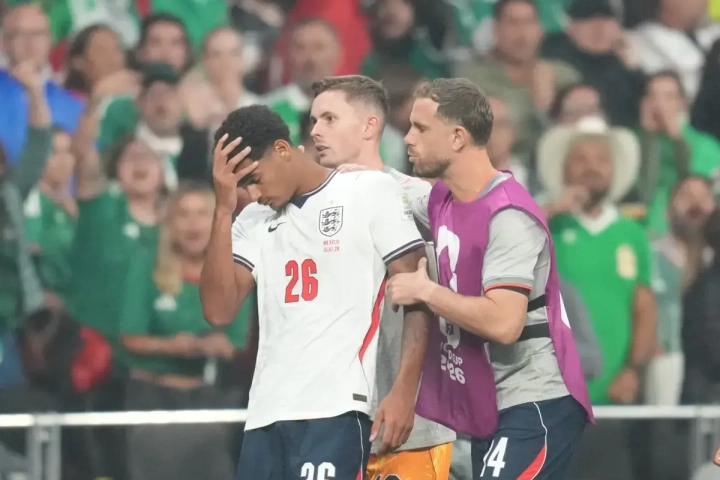
To fully understand the sheer frustration emanating from the England camp, one must revisit the chaotic events of Monday evening in Mexico City. In the 54th minute of a fiercely contested knockout tie, Quansah, who has enjoyed a stellar season playing his club football for Bayer Leverkusen, stretched to make a challenge on Mexico’s left-back, Jesús Gallardo.
In real-time, the tackle appeared robust but not necessarily malicious, with Quansah making contact with the ball before his momentum carried him into Gallardo, catching the Mexican high on the shin. The on-field referee, Alireza Faghani, allowed play to continue, evidently judging the challenge to be a hard but fair byproduct of knockout football.
However, the Video Assistant Referee (VAR) intervened. Faghani was called over to the pitch-side monitor to review slow-motion replays and freeze-frames. The English Football Association (FA) later expressed deep concern regarding the sequence of replays shown to the official, arguing that the initial still frame unfairly highlighted the studs-to-shin contact while entirely neglecting the full-speed context of Quansah playing the ball first. Despite these concerns, Faghani overturned his initial decision and produced a straight red card for serious foul play. England were forced to play the final 36 minutes with ten men, relying on incredible defensive resilience to see out a famous 3-2 victory.
The Uncompromising FIFA Ruling
Any lingering hopes that the context of the challenge might result in a lenient sanction were entirely extinguished on Thursday evening. The FIFA Disciplinary Committee released an uncompromising statement, confirming the full weight of the rulebook had been applied to the young defender.
“The FIFA Disciplinary Committee has imposed the following sanction on England’s national-team player Jarell Quansah, who was sent off as a result of a direct red card during the FIFA World Cup 2026 match between Mexico and England played on July 5, 2026,” the official statement read. It confirmed a “Two-match suspension for a breach of article 14 of the FIFA Disciplinary Code.”
This ruling guarantees that the 23-year-old will play no part in Saturday’s quarter-final against Norway. Furthermore, should England successfully navigate that daunting fixture, Quansah will also be ruled out of the semi-final. For a young defender participating in his first World Cup, it is a devastating personal blow. For the FA, who reportedly attempted to put forward mitigating evidence during the disciplinary process, it represents a deeply frustrating bureaucratic brick wall.
The Balogun Precedent and Cries of Hypocrisy
The frustration surrounding Quansah’s ban is not solely rooted in the refereeing decision itself, but rather in the glaring inconsistency of FIFA’s disciplinary framework at this tournament. Historically, World Cup regulations are absolute: there is no right of appeal against a red card, and a mandatory suspension must be served.
Yet, this supposedly ironclad rule was entirely dismantled less than a week ago. Following a straight red card for a dangerous tackle during the USA’s victory over Bosnia and Herzegovina, American striker Folarin Balogun was facing an identical ban. However, following an extraordinary and highly publicised telephone call from US President Donald Trump to FIFA President Gianni Infantino, the governing body discovered a previously obscure loophole. Invoking Article 27 of the disciplinary code, FIFA miraculously suspended Balogun’s one-match ban for a 12-month probationary period, clearing him to play.
The contrast between the two cases has sparked absolute fury among the English fanbase and global football commentators. Social media platforms have been awash with accusations of favouritism and political capitulation. “Two games for Quansah but Balogun gets off scot-free after a Trump phone call? FIFA is a joke,” read one viral post on X, encapsulating the public mood. Another frustrated supporter pointed out, “Different rules for different nations. FIFA consistency: Does not exist.”
What Has Been Said: Tuchel and the Squad React
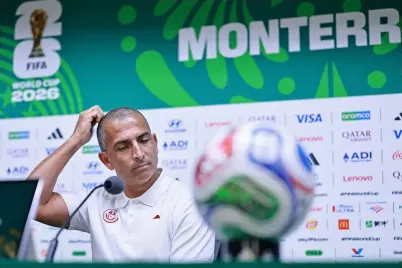
Thomas Tuchel was utterly scathing in his assessment of the governing body’s erratic governance.
“Where does this start and where does this end now?” Tuchel demanded during a heated press conference. “Can we overturn Quansah’s red card or not overturn it? What’s going on? Where to draw the line is the question that I ask. I have no answer to that.”
The England squad members have also voiced their disappointment, albeit with a slightly more diplomatic tone given the impending quarter-final focus. Winger Bukayo Saka expressed the collective frustration of the dressing room: “I just found out. Very frustrating for sure, but it is what it is. We have to deal with it, adapt and get ready. I don’t know what to say [about Balogun’s red card being suspended]. It was FIFA’s decision.”
Midfielder Nico O’Reilly added his sympathy for his young teammate: “I’m gutted for him and he’s not happy about it… but the decision is made now and he’s got his head around it.”
A Broader Crisis of Consistency
The Quansah and Balogun saga is merely the tipping point of a wider debate regarding refereeing standards and the implementation of VAR at the 2026 World Cup. Thus far, the tournament has witnessed 13 red cards, a staggering increase compared to the four red cards issued at each of the previous two tournaments.
While protecting player safety is paramount, the threshold for intervention has appeared wildly inconsistent. Fans and pundits have noted instances where high-profile challenges have gone completely unpunished, while marginal tackles are forensically dissected by the video assistant. For instance, Declan Rice was booked early in the Mexico game for a high boot, yet replays showed his opponent’s boot was equally high. The lack of a uniform standard across different matches and officiating crews is breeding a culture of mistrust and deep frustration among players and managers alike.
Tuchel’s Tactical Headache
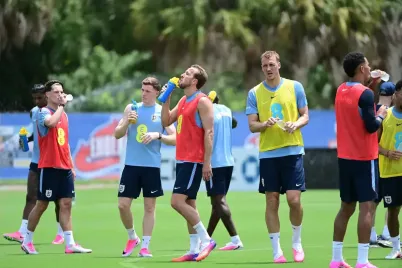
While the political debate rages in the boardrooms, Tuchel is forced to deal with a severe logistical crisis on the training pitch in Florida. England’s defensive options, particularly on the right flank, are looking dangerously thin.
Chelsea captain Reece James, arguably the most natural right-back in the squad, has been plagued by hamstring trouble since the group stage draw with Ghana. He missed the Mexico clash entirely and was seen training separately from the main group on Wednesday, following an individual rehabilitation programme. His availability for Saturday is highly doubtful, and risking him against the raw physicality of Norway could prove disastrous.
This leaves Tuchel scrambling for makeshift solutions. Djed Spence has deputised at times but has struggled to find consistent form on the global stage. Ezri Konsa, traditionally a central defender, was forced to shift to the right flank for the final half-hour against Mexico following Quansah’s dismissal. Tuchel could opt to start Konsa there against Norway, bringing John Stones back into the central defensive partnership alongside Marc Guéhi.
Alternatively, Arsenal midfielder Declan Rice has repeatedly demonstrated his versatility, remarkably finishing the match against DR Congo in an emergency right-back role and filling in at the back during the chaotic final moments against Mexico. However, moving Rice out of the midfield engine room would severely weaken England’s core structure at a time when they need maximum stability.
Facing the Norwegian Threat
Whoever is tasked with patrolling the right side of England’s defence will face the ultimate baptism of fire. Norway arrives in Miami brimming with confidence having orchestrated one of the greatest shocks in World Cup history by eliminating five-time champions Brazil in the Round of 16. Spearheaded by the unstoppable Erling Haaland, who netted twice against the South Americans to take his tournament tally to seven, the Norwegians are a terrifying offensive prospect.
England will have to overcome not only the immense physical threat of Haaland but also the psychological blow of losing a key defender to a highly controversial FIFA ruling. The Three Lions have proven their resilience time and again in this tournament, but Saturday will demand a monumental effort. As the countdown to kickoff continues, the bitter taste of FIFA’s perceived double standard will undoubtedly serve as additional fuel for an England side desperate to prove they can overcome any obstacle, whether it is placed there by an opponent or by the governing body itself.