
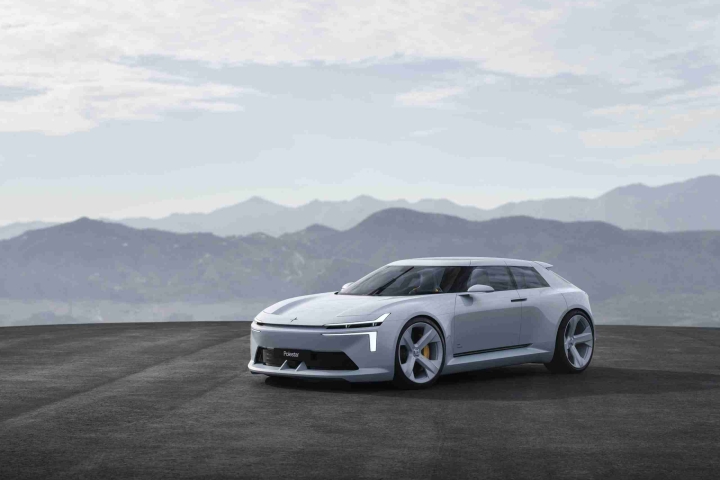
Polestar, the Swedish electric performance car brand, previews its future design direction with the official reveal of the Formula 2030 concept car. Designed as the physical manifestation of the brand’s wider Formula 2030 strategy, the concept brings that strategic direction to vehicular life.
A bold evolution of the design DNA so firmly established since the very start of Polestar, the Formula 2030 concept is the first showcar created under the leadership of Head of Design Philipp Römers. Working with the original Polestar formula to remove the unnecessary, improve what remains and refuse to compromise, the Formula 2030 concept embodies the evolved values that define the brand: design, performance, and sustainability.
Philipp Römers, Head of Design at Polestar, says: “Design should always reflect the values and mission of a brand and that is exactly what we did with Polestar Formula 2030 concept. It is a physical embodiment of how we apply Polestar‘s core values of design, performance and sustainability to the next production cars. A bold evolution of our already well-established design DNA to strengthen the brand‘s positioning with performance at its heart.”
Exterior
The compact practical four-door sports car sits within its own segment, 4,680 mm long, 2,021 mm wide with a 2,780 mm wheelbase, and roof height just 1,350 mm from the ground – even lower than the Polestar 5 Grand Tourer. That positions the car somewhere between the forthcoming Polestar 2 and Polestar 7 dimensionally, and takes inspiration from the recently launched Polestar 4 SUV for its hint towards low-slung practicality.
Viewed from the side, the proportions deliberately express power and performance, with a modern evolution of the classic cab rearward stance set into powerful rear haunches. The long bonnet, short overhangs and 22-inch wheels continue the expression while in plan-view the typical Polestar shape, with coke bottle hips and power visually weighted to the rear, is particularly evident.
Its signature Dual Blade headlights provide the Formula 2030 with an instantly recognisable Polestar character, previewing the face of the next generation Polestar 2 planned for 2027. With inspiration from the Polestar 3, the Dual Blades are neatly integrated into a front aero wing to maintain a strong Polestar identity and amplified presence. The shark nose emphasises performance with a deep front splitter anchored to the body through a central spine. The showcar is unmistakably focused, low and with purpose to its wide stance, confirming its performance credentials.
Continuing through the central spine is an individual, vertically orientated windscreen wiper, aping motorsport cars old and new, mounted on a visor-like wraparound windscreen that pays homage to the first generation Polestar 2. A concealed LiDAR unit, hidden beneath an aerodynamic shroud when not in use, reveals itself when the driver is making use of the Formula 2030 concept car’s autonomous drive capabilities. Behind sits the familiar guiding star symbol projected into the panoramic glass roof.
At the UFO-esque rear, Formula 2030 ushers in a new era of lighting signature, with the now ubiquitous lightbar removed and Polestar’s Single Blade rear lights introduced ahead of series production. Instantly recognisable, the rearward down-the-road graphic is a bold evolution of the geometric shape and sharp angles that have come before.
Like the front screen the rear glass also looks to wrap around the car into the shallow side glazing, intersected only by the strong C-pillar running from powerful rear haunches into the roof, expressing solidity and performance. The rear wing is affixed centrally via lit mounts, while the lower rear diffuser points to the considered aerodynamics and downforce for the powerful electric concept.
Nahum Escobedo, Head of Exterior Design at Polestar, says: “We wanted to evolve, while respecting, the core design values we demonstrated with previous models that define the Polestar brand in such a recognisable way. And with Formula 2030, with its clear Polestar design attributes like the Dual Blade headlights, wraparound visor-like windscreen and powerful haunches, we have done just that. But we’ve pushed perceptions, preconceptions and the expected as well, with our considered choices in form language, amplification of the performance topic and new detailing like the Single Blade rear lights.”
Interior
The Formula 2030 concept continues its evolution and inspiration mission with a performance-focused cockpit concentrated towards the driver. At the centre of attention is the 20-inch HyperDIM, a precisely curved Driver Information Monitor, mounted directly to the steering column always ensuring optimum focus for the driver. The 12.2-inch Centre Screen Display (CSD) is integrated into the gently rising centre tunnel, which is designed to emphasise the importance of the driver’s primary position in the vehicle.
The horizontal interior band, similarly seen in Polestar’s production cars, wraps around the driver before flowing through the rest of the cabin bathed in indirect lighting. These design attributes point towards future Polestar interiors and provide the clearest indication of what comes next for the brand.
The Air Inflatable bolsters and cushions of the four individual seats mould themselves to each occupant for optimum lateral and longitudinal support and are deliberately positioned low-down in the cabin to provide a performance-focused seating position.
Three different drive modes, Performance, Normal and Autonomous, are selected by sliding the drive mode selector forward through the plane of the centre console. By doing so the physical attitude of the CSD and driving position are influenced to reflect the mode chosen. In Autonomous mode the CSD remains upright and proud of the upper IP, providing easily read information relevant to that chosen setting while the seat and steering wheel move away from each other as the vehicle takes more control. As the driver moves through Normal mode to Performance, the CSD lowers further and sits flush into the surface while the steering wheel – and HyperDIM – pull themselves closer to the driver’s chest, optimising the cabin for enthusiastic driving.
Polestar is committing to rebalance the mix of physical and digital with a mechatronics solution for its controls, thanks to a panel of physical controls positioned below the CSD. Entirely customisable, both physically – allowing users to choose between different types of control such as rocker switches or rotary controllers – and digitally, these eight controls provide quick and easy access to the most used functions in the car. Individual hot keys can also be programmed to provide user-defined functions.
Juan Pablo Bernal, Head of Interior Design at Polestar, says: “With the Formula 2030 concept we’re reducing the unnecessary, distilling the experience to its very essence and enhancing the elements that truly matter to set the tonality and ambition for future Polestar interiors. As a performance brand, we see a renewed focus on the driver, and so we re-balance the digital and physical. We introduce physical buttons and controls, and we believe we have achieved a tactile harmony suited for our premium positioning.”
The UX and UI experience of Formula 2030, both physically and digitally, is designed to promote that further and has evolved to maintain the tone in tone theme introduced elsewhere in the concept. Clearly presented information, designed not to distract the driver, that is easy to operate on the move, is a Polestar hallmark with clearly presented brand-specific typefaces and control icons. As with Polestar’s production vehicles, Google Gemini is integrated into Formula 2030 with Google built-in, providing advanced AI for all vehicle occupants through a natural, conversational voice experience.
Colour material and finishes
Formula 2030 showcases a new exterior colour, Nitrogen, which is specific to the concept and designed to react dynamically to natural light. Flowing over the body, including the 22-inch centre lock four-spoke wheels, the side cladding, front splitter and rear aero diffuser, the colour extends over the entire car in a Scandinavian tone in tone expression. Variations of gloss, matt and satin finishes continue the theme, while allowing each individual component to stand proud. Swedish Gold, the brand’s Performance signature, is found on the Brembo brake calipers – engineered to enhance braking performance and provide precise modulation and response – valve caps, interior detailing and seat belts as a strong accent on Formula 2030.
Maria Uggla, Head of Colour Material and Finishes at Polestar, says: “With the Formula 2030 concept we knew we had to do something that stands out, but we had to do it in a true Polestar way. The resulting tone in tone treatment flows effortlessly between interior and exterior, feeling deeply rooted in our Scandinavian minimalist aesthetic in an unexpected and unseen way. Combined with our drive forward for deeply desirable, highly designed, sustainable materials the Formula 2030 points directly towards our future.”
The next step in Polestar’s charge towards designing with sustainable materials and circularity in mind is also taken with the Formula 2030 concept. Continued development of the mono-material strategy, with the interior of the doors offering full recyclability, is combined with exposed structural interior parts such as the seat frame and cross car beam made from low-emission galvanized steel. This is achieved through use of recycled raw material and renewable energy, which based on research is one of the most impactful ways to achieve climate neutrality in the future.
Opposing doors open for pillarless, easy access to the four seats in the spacious but performance-focused cabin where the tone in tone theme continues with subtle transitions across different surfaces and textures. The seat back is made from a bio-based composite, replacing traditional virgin plastics, that combines European flax and bio-based polypropylene in a signature grid weave and colour inspired by the fields that provide the raw material.
Beneath the transparent boot floor, bespoke Polestar bags are secured with Swedish gold luggage staps. Lifting the rear clamshell for access the luggage area deliberately exposes the body structure, showcasing Bcomp’s natural fibre composite with Polestar’s signature weave. The concept’s race-inspired Öhlins dampers are also proudly on show, while the front luggage compartment – providing dedicated space for race helmets and a fire extinguisher – is framed by a Swedish gold strut brace.
The Formula 2030 concept car made its global debut during the recent media drive of Polestar 4 SUV, one of the cars that influenced the concept’s form, which is available here: https://www.polestar.com/polestar-4-models/polestar-4-suv.