
Following the sheer exhilaration and fluidity of their 4-2 opening victory over Croatia, England’s 2026 FIFA World Cup campaign crashed back down to a frustrating reality on Tuesday night. In the damp, cool conditions of the Boston Stadium, Thomas Tuchel’s side laboured to a deeply underwhelming 0-0 draw against a dogged and meticulously organised Ghana side.
While the point effectively guarantees both nations’ progression to the Round of 32, leaving them joint-top of Group L with four points apiece, the manner of the performance will inevitably raise familiar and uncomfortable questions back home.
England completely dominated the ball, hoarding possession and registering 19 shots to Ghana’s two. Yet, for vast stretches of the encounter, they looked utterly bereft of attacking ingenuity. Against a Black Stars side that deployed a textbook low block, the Three Lions were ponderous, static, and lacking the requisite verticality to break the lines.
Here is a deep tactical analysis of exactly where England faltered in Massachusetts, the defensive genius of Carlos Queiroz’s blueprint, and the late penalty drama that nearly tipped the scales entirely.
The Queiroz Masterclass: Suffocating the Centre
To understand England’s bluntness, one must first applaud the tactical execution of Ghana’s head coach, Carlos Queiroz. Renowned globally for his pragmatic tournament mastery, the veteran manager set his side up in an incredibly disciplined 5-4-1 formation, which frequently morphed into an impenetrable 4-5-1 when out of possession.
Queiroz correctly identified that England’s primary threat against Croatia came through the central channels, particularly via the powerful, driving runs of Jude Bellingham and the fluid movement of Anthony Gordon. In response, Ghana completely congested the middle of the pitch. Thomas Partey and Kwasi Sibo operated as a twin midfield pivot that sat absurdly deep, essentially forming a secondary defensive barrier just five yards ahead of their centre-backs.
This strategy forced England to shuttle the ball out wide to their full-backs, Reece James and Djed Spence. However, whenever the ball went wide, Ghana simply shifted their block horizontally, allowing wing-backs Gideon Mensah and Marvin Senaya to engage while leaving absolutely no space in behind for England’s wingers to exploit.
The result was a historically sterile opening 45 minutes. It was a half punctuated by perspiration rather than inspiration, with Declan Rice’s long-range free-kick sailing over the bar serving as the only fleeting moment of note. As a testament to Ghana’s suffocating shape, the match became the first at the 2026 FIFA World Cup to see both sides fail to register a single shot on target in the first half.
The Isolation of Harry Kane
The most glaring symptom of England’s tactical paralysis was the complete isolation of their talismanic captain. Harry Kane, who looked razor-sharp netting twice in the opening victory against Croatia, was rendered entirely anonymous for the first hour of the match.
The statistics from the first half highlight his struggles. Kane managed just nine touches of the ball, and only two of those came inside the Ghanaian penalty area. Constantly marshalled by a trio of imposing centre-backs, Jonas Adjetey, Jerome Opoku, and Abdul Mumin, Kane was entirely starved of service.
When the 32-year-old attempted to drop deep into the number 10 position to link play, a hallmark of his game, he was instantly tracked by Partey, who legally and physically disrupted his rhythm. Without runners like Gordon or Noni Madueke consistently darting beyond Kane to stretch the Ghanaian backline, England’s attacking play became entirely predictable.
When Kane finally did manage to fashion a shooting opportunity from the edge of the box around the hour mark, his left-footed effort lacked the requisite venom to trouble Ghana’s stand-in goalkeeper, Benjamin Asare, who commanded his area with supreme confidence throughout the night.
The Penalty Scare and Ghana’s Threat
While England controlled the tempo, Ghana occasionally served a stark reminder of their counter-attacking threat. Deploying the blistering pace of Iñaki Williams alongside the sheer physical presence of Jordan Ayew, the Black Stars consistently looked for the classic “smash and grab” in transition.
Their most dangerous moment arrived via the substitutes’ bench. In the 78th minute, Prince Kwabena Adu latched onto a direct through ball and drove aggressively into the English penalty area. As Ezri Konsa desperately tracked back to recover, the defender appeared to knock Adu to the ground without making any visible contact with the ball.
The Boston Stadium held its collective breath, but the referee immediately waved away the appeals. Surprisingly, the VAR officials in the booth opted against instructing an on-screen review. It was an incredibly fortunate escape for Thomas Tuchel’s side; in many other circumstances, a challenge of that nature results in a penalty and a potential 1-0 defeat.
Tuchel’s Adjustments and the Late Barrage
Recognising his side’s desperate need for an attacking spark, Tuchel finally turned to his bench. Between the 65th and 83rd minutes, he introduced Nico O’Reilly, Bukayo Saka, Morgan Rogers, Eberechi Eze, and Marcus Rashford.
The sheer volume of attacking talent finally began to stretch the fatigued Ghanaian legs. Madueke, who had shifted to the left flank following Saka’s introduction, saw a deflected shot spin wide, while Eze immediately added much-needed ball-carrying ability in the half-spaces, driving at the tiring defenders.
In the final 10 minutes, the pattern of the game entirely shifted into a relentless English siege. Winning a succession of late corners, the Three Lions put Asare’s goal under immense, sustained pressure.
Then came the golden chance. In the 88th minute, a beautifully recycled passage of play resulted in Reece James whipping a delicious cross to the back post. The substitute O’Reilly rose majestically, thundering a header that beat Asare entirely, only to watch in agony as it cannoned back off the underside of the crossbar.
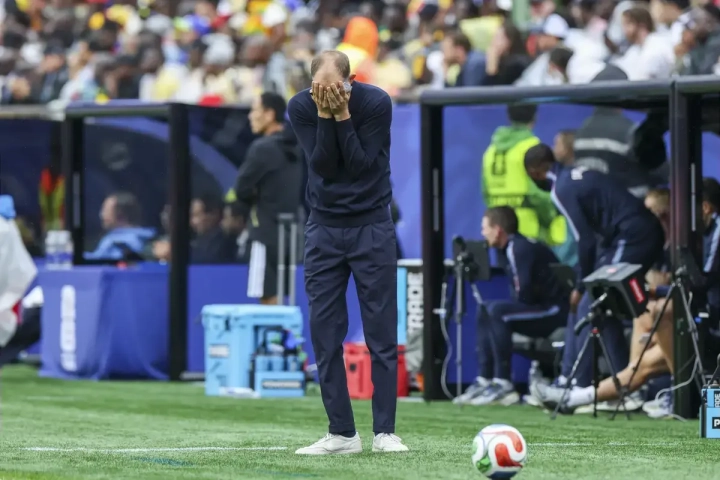
As fate would have it, the rebound fell perfectly to the usually dependable Harry Kane on the six-yard line. Yet, leaning back under intense defensive pressure, the captain blazed his effort wildly into the Massachusetts night sky. Tuchel could only look on from the touchline in sheer disbelief. Marc Guéhi thought he had snatched it in the 93rd minute with a goal-bound header, but it was miraculously flicked off the line from one of a string of desperate corners, cementing the 0-0 scoreline.
The Verdict: A Familiar Tournament Pattern
A familiar sense of tournament déjà vu has descended upon the England camp. Incredibly, this is the fourth time in their last five major tournaments that England have drawn their second group-stage match 0-0 following a positive opening result.
While the draw is by no means a disaster, England have still never lost to African opposition at a World Cup and remain in a prime position to advance as group winners, it serves as a stark reality check. The ability to break down deep, stubborn, low-block defences remains the ultimate tactical puzzle for this squad, one that they have historically struggled to solve.
Speaking to the BBC after the match, Kane was reflective but optimistic about their overall position: “We had some chances there, obviously. I had a big chance there. We hit the bar with Nico as well… it could have easily been a game where we came away with a win. We wanted to win, but we take the point, and we’re still in a great position in the group.”
With four points safely on the board, England now look towards their final Group L fixture against Panama at the MetLife Stadium on Saturday. Tuchel must use the coming days on the training ground to fine-tune an attacking engine that looked decidedly rusty in Boston, ensuring that when the unforgiving knockout stages arrive, his side are ready to shift back into high gear.