
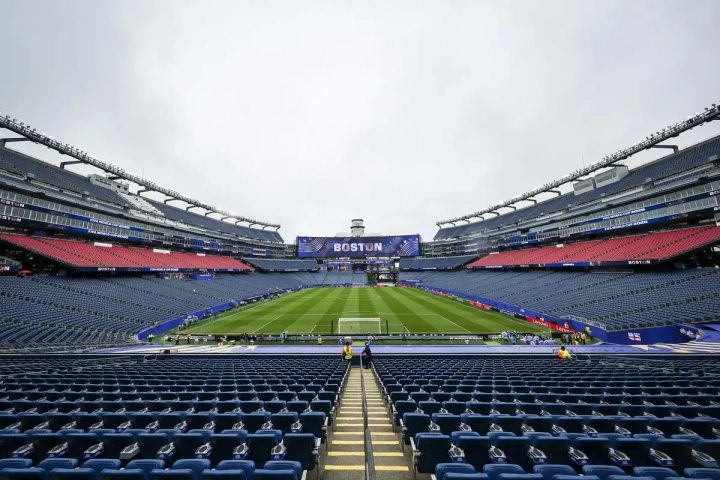
Germany and Paraguay meet in Boston tonight with the comfort of the group stage gone and the unforgiving edge of knockout football now shaping every decision, every duel and every mistake. The FIFA World Cup round of 32 tie takes place on Monday, 29 June 2026, at Boston Stadium, better known as Gillette Stadium, in Foxborough, Massachusetts, with kick-off at 9.30pm UK time and 4.30pm local time.
For Germany, this is the point at which a promising campaign must become something more substantial. Julian Nagelsmann’s side topped Group E, but they arrive in the knockout phase with their momentum slightly interrupted after a 2-1 defeat by Ecuador in their final group fixture. That result did not prevent Germany finishing first, yet it has ensured their meeting with Paraguay carries an added layer of scrutiny.
Paraguay reach this stage with the confidence of a side that has already survived adversity. Gustavo Alfaro’s team progressed as one of the best third-placed nations after finishing behind the United States and Australia in Group D, but their path to the knockouts was built on resilience rather than fluency. A heavy opening defeat was followed by a battling win over Turkey and a disciplined goalless draw with Australia.
That contrast gives the tie its intrigue. Germany have the stronger squad, deeper attacking options and the expectation of a nation used to viewing the latter stages of World Cups as familiar territory. Paraguay have a different kind of strength, forged through difficult South American qualifying and sharpened by the knowledge that organisation, patience and defiance can unsettle more celebrated opponents.
Nagelsmann remains one of the most closely watched managers in international football. Appointed in September 2023, he has been tasked with restoring Germany’s authority after years of tournament frustration. The group stage showed signs of progress, particularly in the 7-1 victory over Curaçao and the late win against Ivory Coast, but the loss to Ecuador revived questions about balance, selection and consistency.
Germany’s most recent competitive fixture was therefore not just a defeat, but a reminder of how quickly the tone around the team can shift. They had already secured top spot, but Nagelsmann still fielded a side strong enough to win the match. The performance lacked rhythm at times, and Ecuador’s ability to disrupt Germany’s control offered Paraguay a possible template, even if the tactical demands of this knockout tie will be different.
There is still plenty for Germany to build on. Deniz Undav has been one of their most effective attacking players at the tournament, while Jamal Musiala and Florian Wirtz remain capable of changing the tempo of a match with one movement between the lines. Kai Havertz gives Nagelsmann another flexible forward option, able to drop short, link play and attack space inside the penalty area.
Midfield control will be central to Germany’s plan. Joshua Kimmich’s influence, whether from deeper zones or in wider areas, remains important to their ability to dictate possession and manage transitions. Around him, Germany need enough defensive security to prevent Paraguay turning isolated counters into moments of real danger.
The confirmed absence of Nico Schlotterbeck is a significant blow. The defender has been ruled out for the rest of the tournament with an ankle injury, reducing Nagelsmann’s options at the back and increasing the importance of Antonio Rüdiger and Jonathan Tah. Nathaniel Brown has been working through fitness concerns, giving Germany another selection issue to manage on the left side of defence.
There are no confirmed German suspension concerns dominating the build-up, which means Nagelsmann’s main challenges are tactical and physical rather than disciplinary. In knockout football, that still leaves plenty to solve. Germany must find a way to move the ball quickly enough to pull Paraguay out of shape without leaving themselves vulnerable when possession is lost.
Paraguay’s situation is different. Alfaro’s side are missing Diego Gómez through suspension, a notable absence in midfield given his energy and ability to influence transitions. Miguel Almirón, however, is available again after serving his own suspension, and his return gives Paraguay a vital outlet in a match where they are likely to spend long periods without the ball.
The fitness of Omar Alderete has also been a concern, though Paraguay’s broader defensive identity does not rest on one player alone. Captain Gustavo Gómez remains the leader of a team built on commitment, aerial strength and collective concentration. Against Germany, those qualities will be tested repeatedly.
Alfaro has spoken throughout the tournament with the belief of a manager who trusts his players’ resilience. Since taking charge in 2024, he has helped revive Paraguay after a poor start to qualification, and the team’s wins over Brazil and Argentina during the South American campaign have become part of their psychological armour. They know the scale of the task, but they also know they have troubled elite opponents before.
Their most recent competitive match, the 0-0 draw with Australia, was not glamorous, yet it was exactly the kind of result that underlined Paraguay’s tournament character. They defended with discipline, accepted uncomfortable periods and did enough to secure progression under the expanded 48-team format. It was a performance rooted in survival, but survival is often the first requirement of knockout football.
Tactically, Paraguay are unlikely to chase the game recklessly. Their best route may be to narrow central spaces, slow Germany’s combinations and force Nagelsmann’s players into wide areas where crosses can be defended. When possession is regained, Almirón and Julio Enciso offer the pace and directness to attack space before Germany can fully reset.
Germany will expect to dominate the ball, but possession alone will not be enough. The key will be speed of circulation and movement around Paraguay’s compact block. Musiala and Wirtz may be asked to receive in tight spaces, while the full-backs must judge when to push high and when to stay connected to the defensive structure.
The historical context adds further weight. Germany and Paraguay have met before on the World Cup stage, most notably in the round of 16 in 2002, when Germany won 1-0 on their way to the final. That match was tight, tense and decided late, a reminder that Paraguay’s reputation for making life uncomfortable for stronger opponents is not new.
For Germany, the memory of 2002 may be distant, but the broader standard remains relevant. This is a nation measured by knockout results. A controlled victory would reinforce belief that Nagelsmann’s project is moving in the right direction; a difficult night would immediately revive the doubts that have followed Germany through recent tournaments.
For Paraguay, the opportunity is enormous. They are back at the World Cup for the first time since 2010 and now have the chance to make a statement that would travel far beyond this tournament. Beating Germany in a knockout match would rank among the country’s greatest football achievements and would validate the hard edge Alfaro has restored to the side.
The wider competition implications are clear. The winner advances to the round of 16, where a meeting with the winner of France against Sweden awaits. That potential next step only increases the importance of tonight’s match. Neither side can afford to look beyond Boston, but both know the route ahead becomes even more demanding from here.
Set-pieces could prove decisive. Germany have height, delivery and movement, while Paraguay traditionally defend with aggression and attack dead-ball situations with conviction. In a knockout tie where open-play chances may be limited, corners and free-kicks could become some of the most important moments of the evening.
Discipline will matter just as much. Paraguay’s tournament has already been shaped by suspensions, and Germany will not want frustration to creep in if the match remains level deep into the second half. The longer Paraguay stay in the contest, the more pressure may transfer towards the favourites.
There is also a mental challenge for Germany after the Ecuador defeat. Strong teams often use setbacks as corrections rather than crises, and Nagelsmann will want his players to show that the final group match was a warning, not a pattern. The first 20 minutes in Foxborough may reveal much about their sharpness and composure.
Paraguay, by contrast, can embrace the underdog role. Their supporters will expect fight, structure and belief. They may not see as much of the ball, but they will know that knockout football rarely rewards reputations alone. One counter-attack, one set-piece or one defensive lapse could alter the entire night.
By the time the teams walk out at Boston Stadium, the storylines will be clear. Germany carry pedigree, talent and pressure. Paraguay bring resilience, recent evidence of upsetting major nations and a squad shaped by hard qualification battles. The prize is a place in the last 16, but the meaning stretches further: for Germany, proof that their rebuild can withstand knockout tension; for Paraguay, the chance to turn defiance into history.